Artemis II
Fifty-four years of silence, then an Earthset.
Half a century after Apollo 17, four astronauts boarded a spacecraft pointed at the Moon — and discovered the silence behind it had been waiting for them.
The return
Reid Wiseman, Victor Glover, Christina Koch, and Jeremy Hansen lifted off from Kennedy Space Center at 6:35 p.m. EDT on a machine that had earned a reputation for temperament — the SLS, with its history of hydrogen leaks and slipped schedules. On this evening, it flew clean. The launch window opened and the rocket simply went, which surprised even the crew.
Two days of coasting brought them to the translunar injection burn. After that, Earth shrank in the windows and the Moon grew. On the morning of April 6, Orion crossed the lunar sphere of influence — the invisible boundary where the Moon’s gravity takes over. Koch marked the moment: the spacecraft was now falling toward the Moon rather than climbing away from Earth.
The far side
The seven-hour flyby began in the early afternoon. The crew photographed Orientale Basin, a 600-mile-wide impact scar straddling the near and far sides, and peered into Vavilov Crater where long shadows sharpened every ridge. They reported six meteoroid impact flashes on the darkened surface — brief sparks of kinetic energy on a world with no atmosphere to slow anything down.
At closest approach — 4,067 miles above the surface — Orion was moving at nearly 61,000 miles per hour relative to Earth but only 3,100 relative to the Moon. For forty minutes behind the far side, the spacecraft vanished from all contact. No relay satellite, no Deep Space Network signal. Just four people and the silence of the Moon’s shadow.
We are now falling to the Moon rather than rising away from Earth.
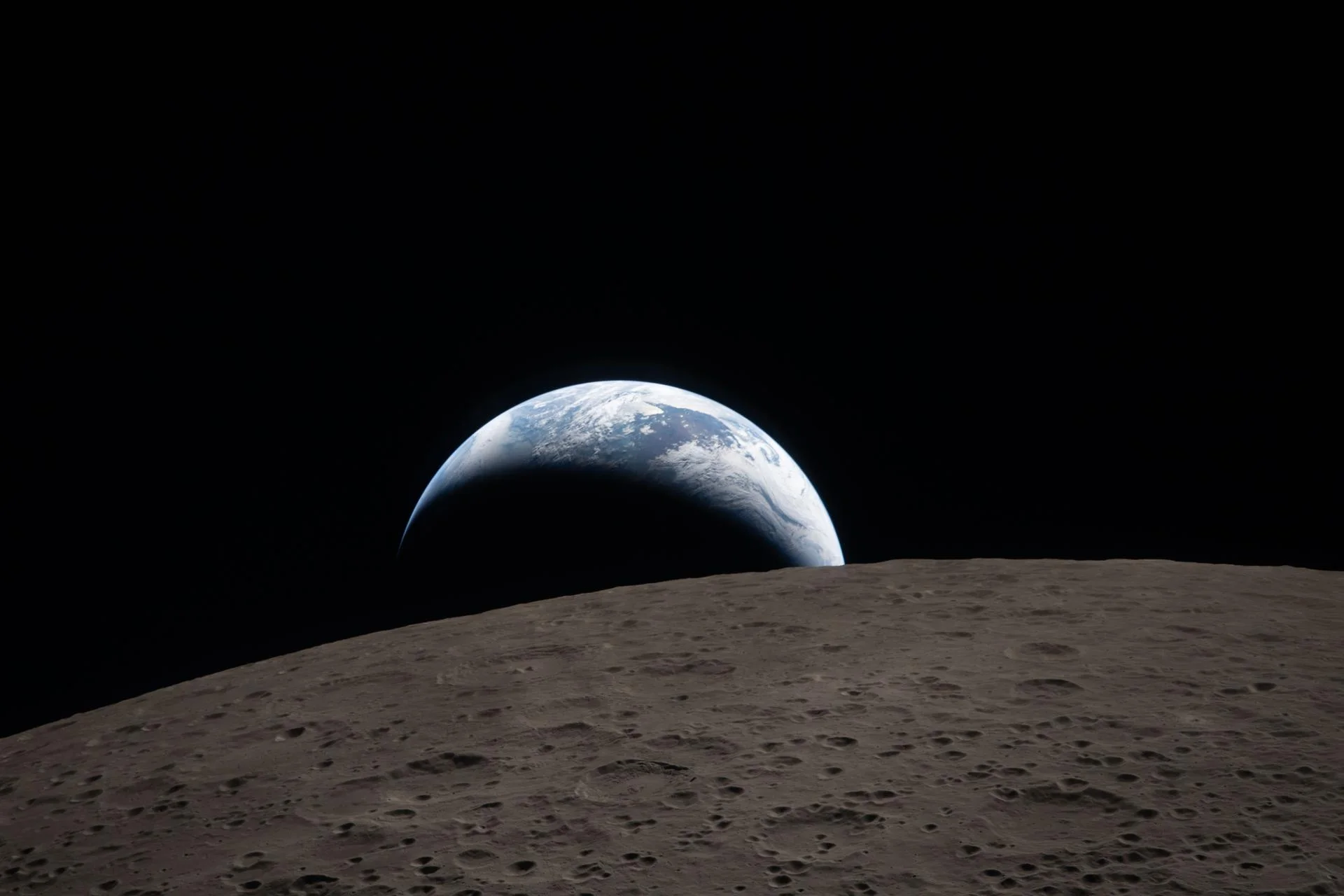
When Orion emerged, the crew watched an Earthrise — the crescent planet lifting above the battered lunar horizon. Then came an event no human had ever witnessed from that vantage: a total solar eclipse lasting fifty-four minutes, the Moon blocking the Sun completely while the corona blazed around its edge. Saturn and Mars were visible in the same frame.
The heat shield
The mission’s sharpest risk was not the Moon but the return. Orion’s Avcoat heat shield carried a known design flaw — unexpected erosion observed after Artemis I in 2022. NASA had modified the reentry trajectory to reduce thermal stress, but entering the atmosphere at Mach 35 and 5,000 °F leaves thin margins. The crew knew the math. Glover had been thinking about reentry since the day he was assigned to the mission, three years earlier.
At 8:07 p.m. EDT on April 10, Orion hit the Pacific at roughly 20 miles per hour off the coast of San Diego. Total mission time: 9 days, 1 hour, 32 minutes, and 15 seconds. Total distance traveled: 694,481 miles. The heat shield held.
The four astronauts stepped onto an inflatable raft, took selfies with the medical team, and waited for the helicopters. They had set a new record for the farthest any human has traveled from Earth — and brought back images dense enough to occupy planetary scientists for years. Artemis III, when it comes, will attempt to land. But Artemis II answered the question that had to come first: whether the machine and the people inside it could survive the trip.
NASA