A Thought Experiment from the Middle Ages
When medieval astronomers reached for the edge of everything.
Aristotle insisted the universe ended somewhere. His medieval inheritors tried to imagine reaching past that end — and the question reshaped physics.
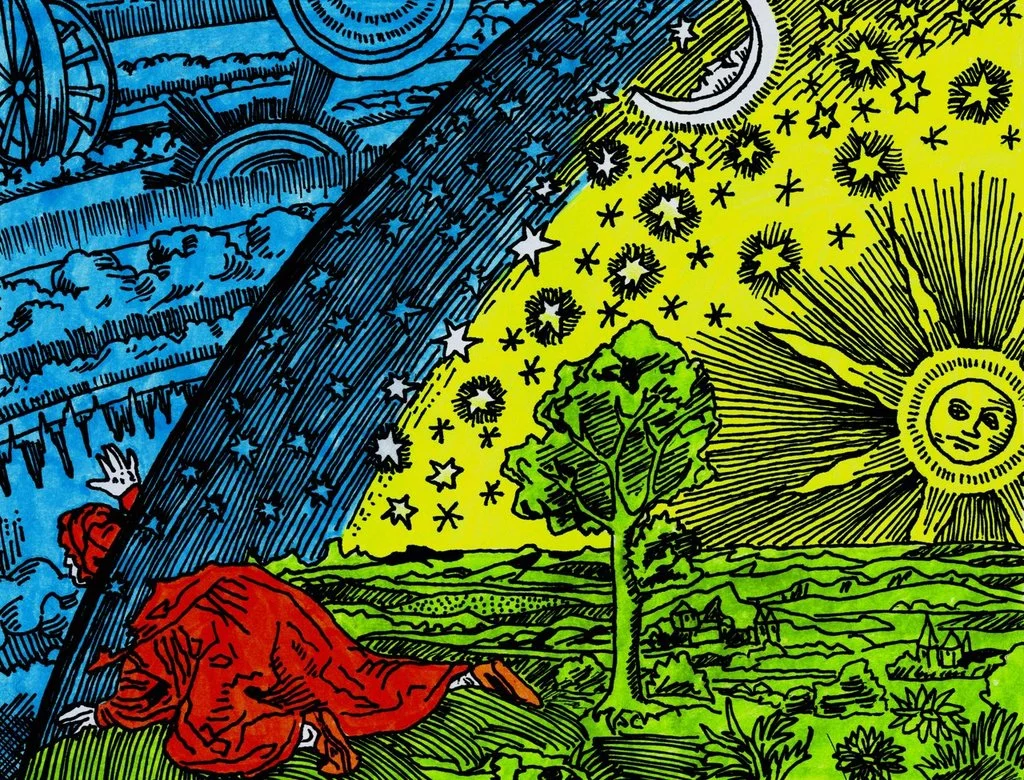
The medieval image of the world descends from Aristotle and Ptolemy. A famous engraving — of deeply contested origin — appeared for the first time in 1888, in Camille Flammarion’s L’Atmosphère: Météorologie Populaire. It seems to depict a thought experiment common among medieval astronomers, tied to the Aristotelian notions of space and finitude.
If a man could travel to the outermost sphere of the fixed stars, what would happen if he tried to stretch his arm beyond it? Would his hand find itself… somewhere?
Rephrased by modern cosmologists, the question becomes simply: what lies beyond the Universe?
Aristotle’s answer
Aristotle’s response to the cosmological quaestio was unequivocal. Beyond the Heaven — meaning the outermost sphere of the fixed stars — there exists neither space, nor void, nor time. Wherever a body can be present, that is a place; the void is where a body’s presence, though not real, is possible; and time is the measure of motion. But in the absence of any natural body there is no motion, and beyond the Heaven no body exists nor can come to exist. Therefore space, void, and time simply do not obtain there.
For Aristotle, then, the Universe is finite: a closed, eternal world contained within a sphere that stands in no place, because beyond it there is only void — understood as the absence of matter, space, and time. Whatever exists beyond the Heaven occupies no space and is subject to no temporal flow.
The question that would not die
What lies beyond the outermost sphere? If the Universe has a boundary, what exists past it? Nothing — not even “empty space”? Or an extra-cosmic void in which God is omnipresent? Could a man stretch his hand into such a void — and would that hand exist somewhere?
The possible existence of an extra-cosmic void, and what might happen if a human were to reach it, became the most debated subjects among medieval cosmologists. Though their inquiries remained purely mental — abstract thought experiments — they played a fundamental role in revising Aristotelian physics, transforming the concept of place into the entirely different concept of absolute space: a three-dimensional, empty, static, Euclidean container for material objects, later adopted by Newtonian physics.
And although roughly a millennium has passed since those medieval cosmologists pursued their thought experiments, understanding the properties and behaviour of space remains one of the foremost objectives of modern physics. In 1917, Albert Einstein declared: space is not simply a void — on the contrary, it is something real, flexible, and extensible.
Camille Flammarion, L'Atmosphere: Météorologie Populaire (Paris, 1888), pp. 163