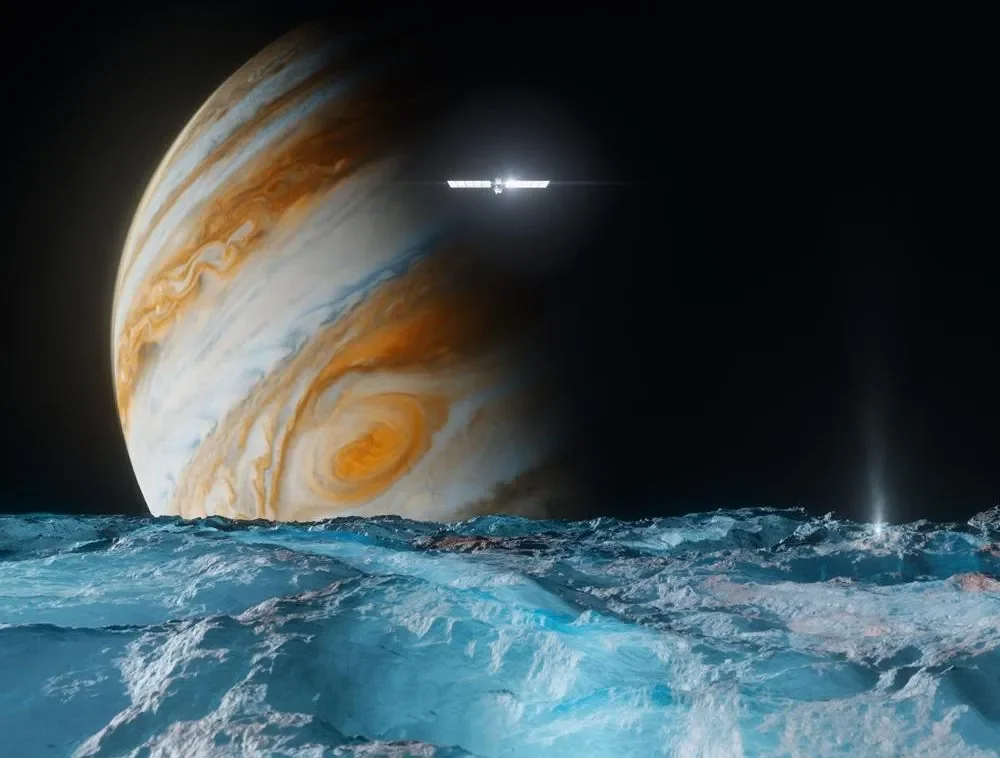
The Oceans of Jupiter's Moons
Beneath the ice, an entire hydrosphere waits in silence.
The four points of light beside Jupiter, easily seen with binoculars, are not stars. Beneath the ice of at least one of them, an ocean is waiting.
Four worlds in slow motion
Jupiter dominates these clear winter nights, high in the constellation of Taurus. A small telescope is sufficient to witness the spectacle: transits, eclipses, shadows cast upon the giant’s cloud bands — a precise choreography governed by gravitation alone. For generations, the Galilean satellites remained little more than points of light. The veil of mystery was torn only when we could observe them at close range.
No one expected what we found.
From the active volcanoes of Io to the smooth, fractured ice of Europa; from the cratered terrains of Ganymede — varying in age and albedo — to the ancient, impact-saturated surface of Callisto. The Galileo spacecraft, orbiting Jupiter since 1995, delivered revelations that redefined planetary science.
The ocean beneath
The greatest surprise was Europa. The magnetometer aboard Galileo detected electric currents circulating near the satellite’s surface — induced by Jupiter’s rotating magnetic field. The most plausible conductor is a global ocean of salt water, perhaps tens of kilometres deep, hidden beneath the ice shell. An alternative — a warmer, softer ice layer — was considered, but models favour liquid water.
The energy source is tidal: Jupiter’s immense gravitational field, modulated by the orbital resonance with Io and Ganymede, flexes Europa’s interior continuously. This tidal heating maintains the ocean in a liquid state and may drive hydrothermal activity on the ocean floor — precisely the environment where, on Earth, life thrives in the absence of sunlight.
Not Europa alone
Ganymede, the largest moon in the solar system, also shows evidence of an internal ocean — sandwiched between layers of ice at different pressures. Callisto, despite its ancient and battered surface, may harbour a deep liquid layer as well. Even Io, seemingly inhospitable with its volcanic fury, contributes to the picture: its tidal dissipation helps sustain the orbital resonances that keep Europa’s ocean warm.
We sent a spacecraft to Jupiter expecting geology. What we found was hydrology — and, perhaps, the most promising address for extraterrestrial life in the solar system.