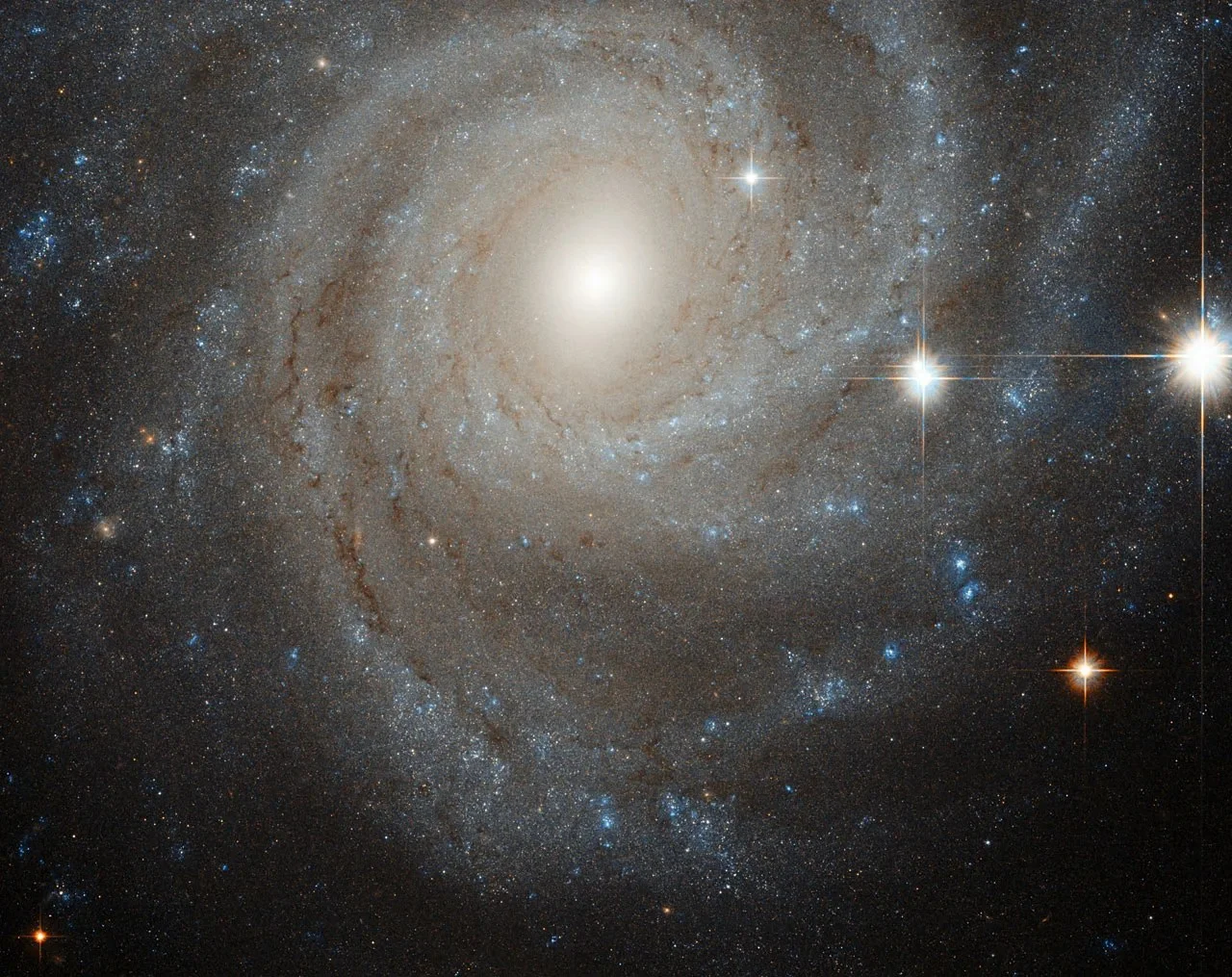
Cosmic Pinwheels
A field guide to the shapes of galaxies.
The first time someone tried to put galaxies in alphabetical order was 1926. The order has changed remarkably little since.
The tuning fork
In 1926, Edwin Hubble used his collection of photographic plates from the 2.5-metre telescope at Mount Wilson to compile the first morphological classification of galaxies. His criteria were purely descriptive — shapes as revealed on glass, with no evolutionary assumptions — yet the broad lines of his scheme remain the foundation of extragalactic taxonomy.
Hubble’s diagram divides galaxies into three principal families: ellipticals, ranging from spherical to strongly flattened; spirals, resembling pinwheels with luminous arms wound about a central bulge; and irregulars, devoid of rotational symmetry or a well-defined nucleus. Between the ellipticals and the spirals lies an intermediate class — the lenticulars.
Ellipticals and spirals
Elliptical galaxies are designated E0 through E7, according to their apparent flattening. They are poor in gas and dust, populated primarily by old, Population II stars. Their range in size is enormous: dwarf ellipticals may contain a few million solar masses within 5,000 light-years, while giant ellipticals can exceed ten trillion solar masses and stretch across 300,000 light-years.
Spiral galaxies possess a disc, a central bulge, and coplanar arms composed of gas, dust, and stars rotating at velocities of 100–300 km/s. Viewed edge-on, a thin dark lane of interstellar dust bisects the nucleus. Hubble further divided spirals into normal (S) and barred (SB), each subdivided by the tightness of the arms and the prominence of the nucleus — from Sa, with tightly wound arms and a large core, to Sc, with open arms and a modest centre.
Beyond the visible
The classification, elegant as it is, captures only what light reveals. We now know that every major galaxy harbours a supermassive black hole at its centre, that dark matter haloes extend far beyond the luminous disc, and that interactions and mergers reshape morphologies over cosmic time. Hubble’s tuning fork was a beginning — a way to impose order on the bewildering variety of island universes — and it remains, nearly a century later, the first thing an astronomer learns when looking beyond the Milky Way.