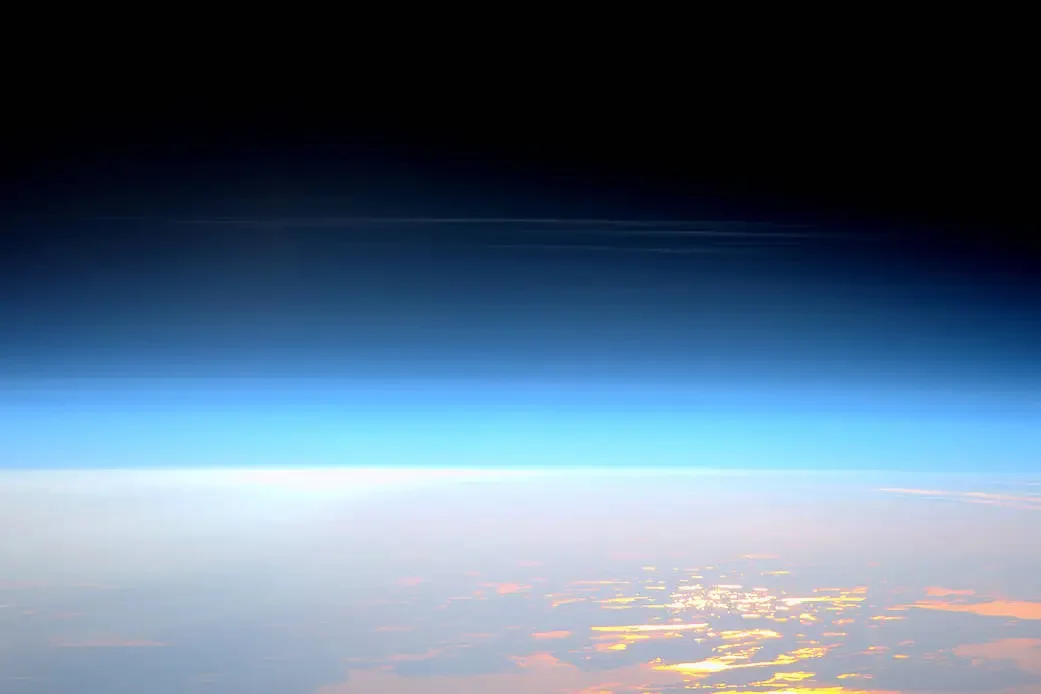
Noctilucent Clouds
Ice crystals at the edge of space, glowing after sunset.
There is a kind of cloud you can only see when the Sun has already set on you but is still rising on it. Eighty kilometres up, in air drier than any desert, ice has somehow learned to form.
Clouds that belong to the night
The troposphere builds its clouds at altitudes up to fifteen kilometres. Noctilucent clouds form five times higher — between 80 and 85 km — in the mesosphere, a region so cold and so profoundly arid that their very existence constitutes a paradox. They consist of minuscule ice crystals, comparable in size to particles of cigarette smoke, and they become visible only when the Sun has already set below the observer’s horizon yet still illuminates the upper atmosphere from below. By day, they are invisible. Against the deepening twilight, they scatter sunlight with an ethereal silver or pearly-blue glow; closer to the horizon, the colour shifts toward gold.
When and where to look
In the northern hemisphere, noctilucent clouds appear most frequently between late May and mid-August — the period of maximum solar illumination. The optimal moment is the long summer twilight, when the Sun lies between 6 and 16 degrees below the horizon, and the most favourable latitudes range between 50° and 60° North. Observers will notice rapid changes in form — undulations, striations, herringbone patterns — driven by turbulent winds in the upper atmosphere.
A pair of binoculars helps distinguish them from high-altitude cirrus: ordinary cirrus appears diffuse and nebulous, while noctilucent clouds reveal crisp, sharply defined structure. Their resemblance to cirrostratus is superficial; their altitude and luminosity betray a fundamentally different origin.
A mystery at the edge of space
The mesosphere is the coldest layer of the terrestrial atmosphere — temperatures can drop below — yet it is also staggeringly dry. How water vapour reaches such altitudes, and how it condenses into ice on nucleation sites that may include meteoric dust, remains an active area of research. Some scientists have proposed a connection between noctilucent cloud frequency and climate change, noting that their sightings have increased over the past century and have been observed at lower latitudes than historically recorded.
They are among the most delicate phenomena the atmosphere offers — visible only in the narrow window between day and night, at the very frontier of space.