The Great Revolution
How Kepler and Galileo dismantled fourteen centuries of cosmic certainty.
Two men, working in different countries with different tools, finished what Copernicus had only begun. Within a single year — 1609 — the heavens stopped being a closed sphere and became something measurable.
The old cosmos
For more than fourteen centuries, the Western world conceived the cosmos according to Ptolemy’s schema: the Earth — immobile, central, the pivot of all things. Stars, Sun, and planets performed their dutiful orbits around humanity, which, as a divine creation, stood not merely as spectator but as the undisputed protagonist. The system of deferents and epicycles served the practical needs of the age with tolerable approximation, but its foundations were anything but physical.
Then, roughly five centuries ago, a process began that would shatter the bond between the scientific conception of the world and religious anthropocentrism. The sixteenth century inaugurated a progressive demotion of the human role — initiated by Nicholas Copernicus with the De Revolutionibus Orbium Coelestium and completed, three centuries later, by Charles Darwin with On the Origin of Species.
Kepler’s laws
The decisive advance came from Johannes Kepler. In 1609, after years of painstaking analysis of Tycho Brahe’s observational data — the most precise ever collected without a telescope — Kepler published the Astronomia Nova, containing the first two of his three laws. The orbits of the planets were not circles but ellipses, with the Sun at one focus. And a planet swept equal areas in equal times — moving faster near the Sun, slower at aphelion. A decade later, the Harmonices Mundi delivered the third law: the square of the orbital period is proportional to the cube of the semi-major axis.
These were not merely corrections to Ptolemy. They were the annihilation of the entire conceptual framework — deferents, epicycles, equants — that had governed celestial mechanics since antiquity. For the first time, planetary motion obeyed simple, universal, mathematically precise laws.
Galileo’s telescope
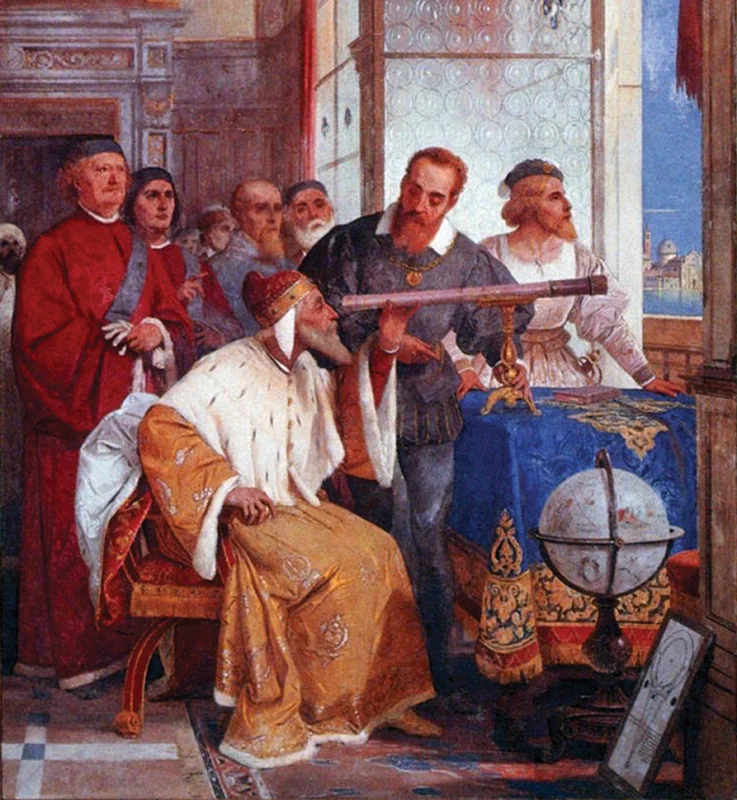
In the same year Kepler published the Astronomia Nova, Galileo Galilei pointed a telescope at the sky and transformed astronomy from a discipline of naked-eye geometry into an observational science. The mountains of the Moon, the phases of Venus, the satellites of Jupiter, the spots on the Sun — each observation drove another nail into the geocentric coffin.
Galileo’s contribution was not merely instrumental. His insistence on experiment and observation as the arbiters of truth — against the authority of Aristotle and Scripture — established the epistemological foundation upon which all subsequent science would be built. The revolution that Copernicus began on paper, Kepler formalised in mathematics, and Galileo confirmed through the lens.
What emerged was a reality far more profound than any superficial analysis could suggest — and, centuries later, still rich with unknowns.