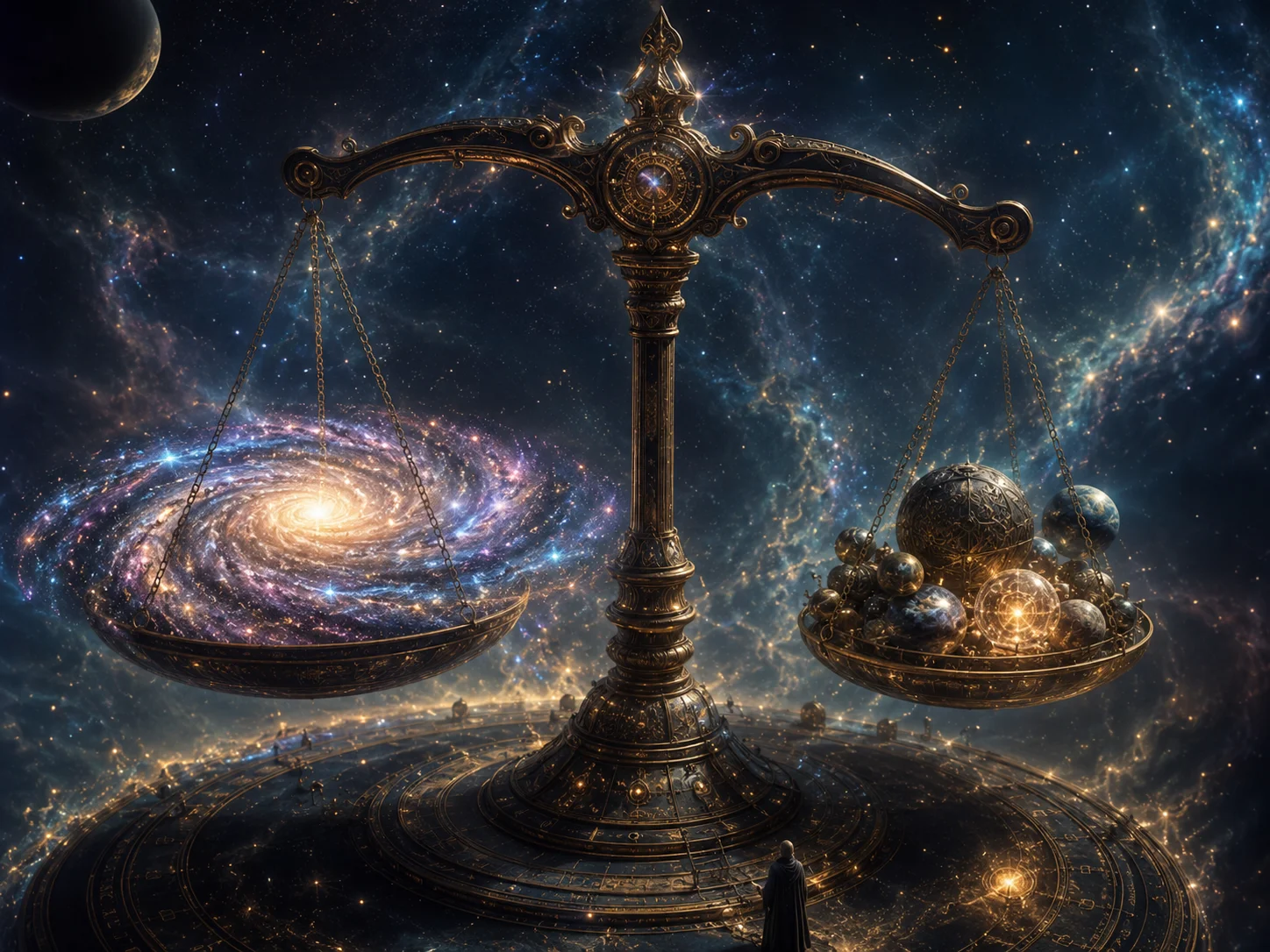
How Much Does a Galaxy Weigh?
The question is poorly posed — and the answer is stranger than the question.
There is no scale large enough to weigh a galaxy. The methods we have invented instead reveal that most of the answer is something we cannot see.
Mass, not weight
Every body possesses mass, and this mass confers upon it a weight that depends on the gravitational field of another body acting upon it. While mass can be considered constant, weight cannot. If I were to measure my weight on Earth and then carry the same scale to the Moon, the reading would be approximately six times smaller.
The first step, therefore, is to determine the total mass using indirect techniques … and then, if one insists, convert that quantity into an equivalent terrestrial weight.
The visible deception
If galaxies were composed solely of stars, the task — though immense — would be conceptually straightforward: count the stars and estimate the mass of each. A galaxy, however, is composed of objects of vastly different natures, the majority of which are not even visible. Stars, gas, dust, stellar remnants, planets, asteroids … all contribute to the gravitational budget. But the dominant component — by an overwhelming margin — does not shine at all.
In the 1930s, Fritz Zwicky noticed that galaxies within the Coma Cluster were moving far too rapidly to be bound by the visible mass alone. Decades later, Vera Rubin’s observations of galactic rotation curves confirmed the pattern on smaller scales: the outer regions of spiral galaxies rotate at velocities that the visible mass cannot explain. The inescapable conclusion was that an enormous quantity of unseen matter — dark matter — pervades every galaxy, extending far beyond the luminous disc in vast, spherical haloes.
How it is done
Modern techniques for weighing a galaxy combine multiple approaches. The rotation curve method measures the orbital velocities of stars and gas at varying distances from the galactic centre; applying Newtonian dynamics yields the enclosed mass at each radius. Gravitational lensing — the bending of light from background sources by the foreground galaxy’s mass — provides an independent measurement that is sensitive to all matter, luminous or otherwise. For the Milky Way, the motions of satellite galaxies and globular clusters serve as dynamical tracers of the total gravitational potential.
The result, for our Galaxy, is approximately 1.5 trillion solar masses. Of this staggering figure, ordinary matter — the stars, the gas, the dust, everything we can see or detect through any wavelength — accounts for roughly 15 percent.
The remaining 85 percent is invisible, intangible, detectable only through the gravitational imprint it leaves upon the luminous matter we observe. We have weighed the Galaxy … and discovered that most of it is made of something we do not yet understand.
chatGPT by openAI