The Story of Stars
From the dust of molecular clouds to the light that reaches our telescopes.
Stars are not visible at the moment of their birth. To find one being made, we have to point a radio telescope at a place where, on the surface, nothing seems to be happening.
A photograph of a crowded street
We had set out early that morning, our programme of 52 water maser sources tucked into our pockets. Observations at the 32-metre dish had already been conducted over the preceding nine years, with considerable results: roughly a thousand sources identified and subsequently monitored — observed regularly month after month — for a total of 33,000 individual measurements. On average, 33 observations per source. The average! A useful parameter behind which anything can hide.
A single observation of a celestial object — be it an asteroid, a planet, a comet, or a galaxy — cannot reconstruct its evolutionary history. It is as though, from a single photograph of a crowded street, one attempted to reconstruct the family histories of every person in it. Yet one may reasonably assume that all “families” are roughly similar, composed of individuals — infants, children, adolescents, adults, the elderly — possessing comparable characteristics. From that single photograph, one can deduce the typical structure of the average family.
Where stars are born
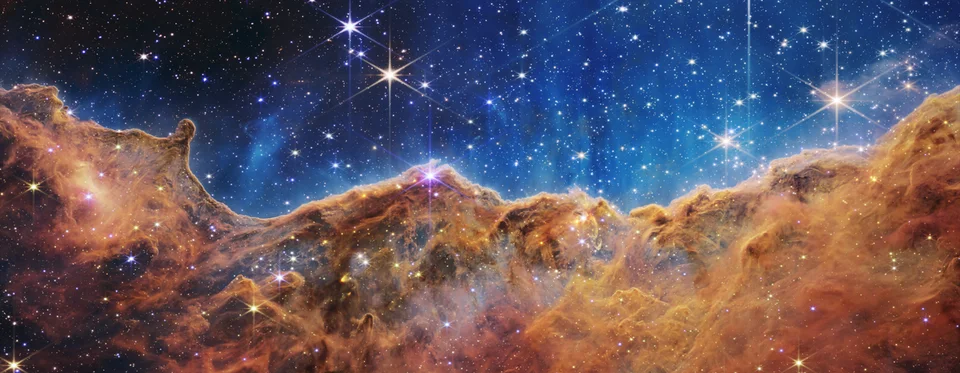
Stars are born in chaos — in a maelstrom of dust, gas, and molecules so dense that the nascent object remains invisible. The interstellar medium contains vast quantities of molecular gas, concentrated principally in clouds of varying dimensions. Unlike their smaller counterparts, giant molecular clouds possess a profoundly inhomogeneous structure. Within them, denser globules of molecular gas collect a disproportionate share of the cloud’s total mass.
These globules are the nurseries.
Imagine a giant molecular cloud, a hundred light-years across, harbouring at least one denser globule in its interior. The presence nearby of one or more very young, massive stars — spectral classes O and B — drives a progressive ionisation of the surrounding environment. An ionisation front advances into the cloud, reaching the denser globule within timescales of to years, while the surrounding gas and dust are literally swept away by complex physical processes.
The sole survivor: the dense globule, compressed by the passage of the ionisation front, within which the process of stellar formation … begins.
From collapse to ignition
Gravitational instabilities, initially localised, trigger the contraction of gas within the globule. The gas heats as it compresses. If the mass involved is sufficient, temperatures eventually reach the threshold for thermonuclear ignition — fifteen million kelvin — and a star is born. The journey from diffuse cloud to luminous object spans millions of years, yet the final stages are comparatively rapid, and many stars emerge almost simultaneously from the same nursery.
What began as an invisible knot of cold gas, hidden within a dusty shroud, becomes a furnace whose light will travel across the galaxy for billions of years.
NASA · ESA · CSA · STScI