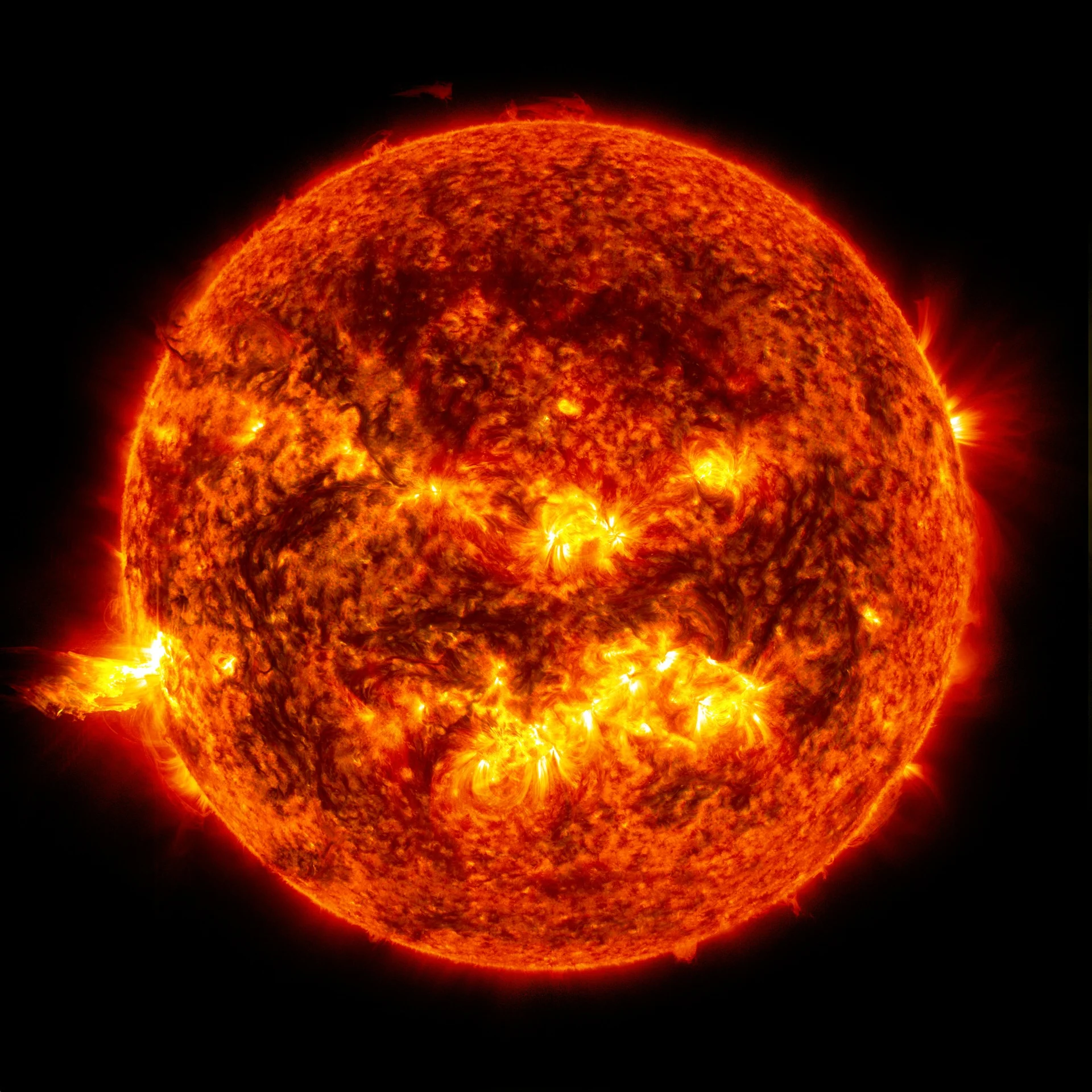
Our Sun
An extraordinarily complex star hiding behind an apparently simple glow.
The Sun appears to the eye as a featureless ball of light. A century of observation has shown it to be the most layered, most paradoxical star we will ever study at close range.
The engine within
We have discovered that the arcane mechanism permitting our star to shine — releasing immense quantities of energy for billions of years — is nuclear fusion. In the Sun’s core, hydrogen atoms fuse to form helium through a series of reactions that produce energy as a by-product. But the process is neither simple nor obvious.
To allow hydrogen atoms to fuse — in practice, electrically charged protons, since atoms at the Sun’s centre are fully ionised — one must overcome the electrostatic repulsion between particles of like charge. The protons must possess an enormous quantity of kinetic energy, furnished by temperatures of fifteen million kelvin. Such temperatures were attained through the gravitational contraction of the primordial molecular cloud from which the Sun condensed — a cloud in which slight, localised gravitational instabilities initiated the collapse.
Structure and stratification
The Sun is not the featureless orb it appears to the unaided eye. Its interior comprises a dense core — where fusion reactions sustain the star’s luminosity — surrounded by a radiative zone through which photons diffuse outward over hundreds of thousands of years, scattered and re-absorbed countless times. Above this lies the convective zone, where energy is transported by vast currents of rising and sinking plasma that imprint the granulation pattern visible on the photosphere.
The photosphere itself — the “surface” we observe — has a temperature of approximately 5,800 kelvin. Beyond it extends the chromosphere and, further still, the corona: a tenuous, million-degree atmosphere whose paradoxical temperature — far exceeding that of the photosphere below — remains one of the great unsolved problems of solar physics.
A star among stars
The Sun belongs to spectral class G2V — a yellow dwarf of moderate mass, unremarkable among the hundreds of billions of stars in the Milky Way. Yet its proximity makes it the only star whose surface we can resolve in detail, the only stellar laboratory where we can observe convective cells, magnetic field lines, sunspots, prominences, and coronal mass ejections in real time.
It is, in every sense, a Rosetta Stone for stellar astrophysics — an apparently simple object whose complexity deepens with every instrument we point at it.