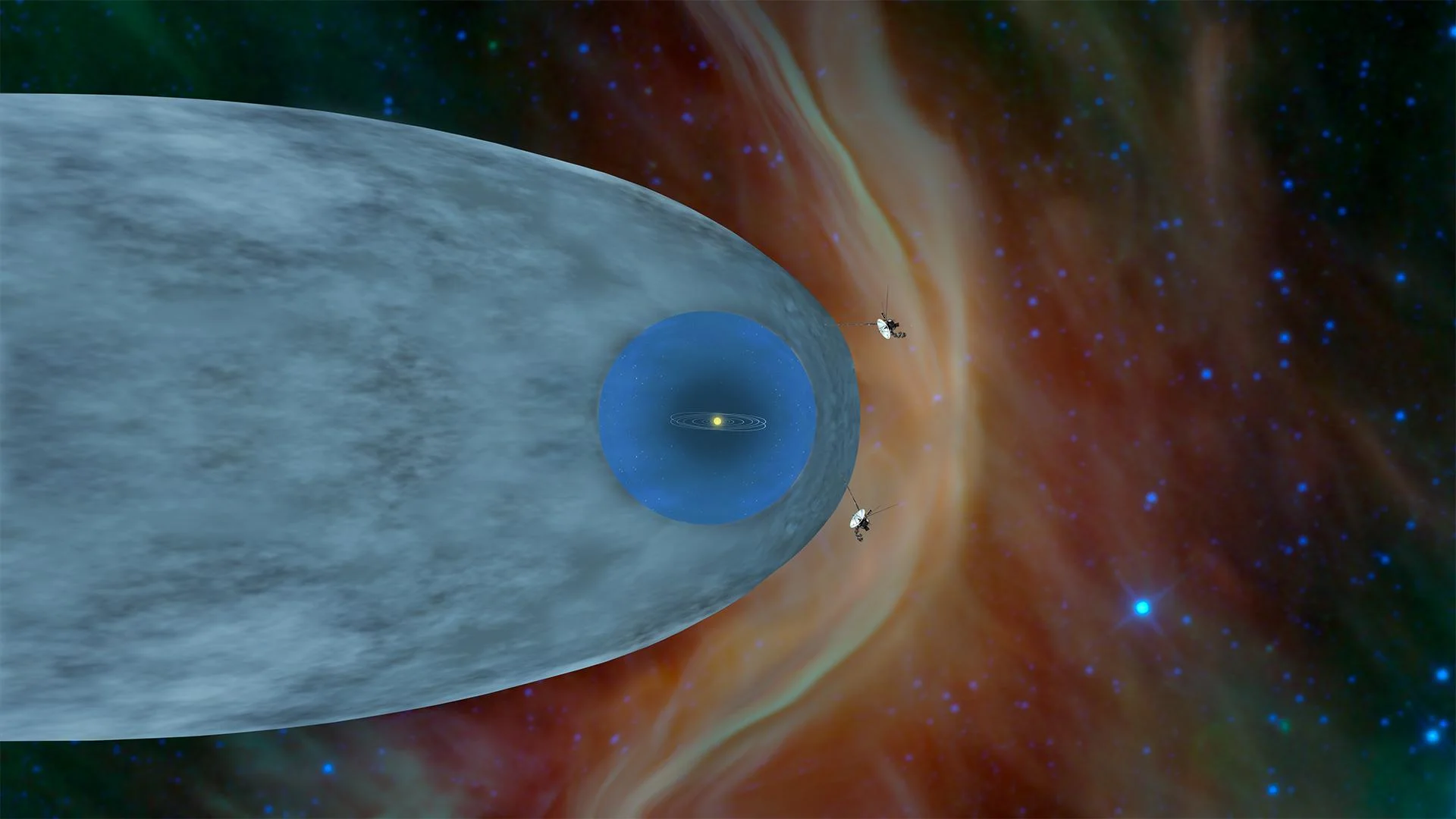
The Solar Neighbourhood
Interstellar matter flows through our planetary system — and has for billions of years.
The Solar System is not sailing through empty space. It is moving through a cloud — and through that cloud's history.
An inhomogeneous sea
The interstellar medium in which our Solar System is immersed is anything but uniform. Astronomers observe clouds of gas and dust displaying elaborate and peculiar structures — filaments, knots, loops — characterised by wildly heterogeneous values of density, temperature, and chemical composition. Over millions of years, these clouds form and disperse as stellar winds and supernova explosions sweep the interstellar medium clean. Consequently, the Sun, throughout its five-billion-year history, must have experienced a remarkable variety of galactic environments.
How does the Solar System respond to these changes? A role of primary importance belongs to the solar wind, which modulates what can and cannot penetrate the inner system — shielding, above all, the most vulnerable regions from the vagabond flux of cosmic particles.
The Local Interstellar Cloud
The cloud that currently envelops us — and has done so for approximately 250,000 years — is designated the Local Interstellar Cloud. It is warm, tenuous, and partially ionised, with a temperature near 7,000 kelvin. Its density is modest: roughly 0.3 atoms per cubic centimetre. This cloud drifts through a far larger, far hotter structure known as the Local Bubble — a cavity of extremely low-density, million-degree gas excavated by ancient supernovae.
The Sun traverses the Local Cloud at a relative velocity of about 26 km/s. At this speed, it will emerge from the cloud in roughly 10,000 to 20,000 years, entering a different interstellar environment whose properties we can only estimate.
A question still open
What happens when the Sun passes from one interstellar cloud into another — particularly into a denser one? The heliosphere would contract, allowing more cosmic rays and interstellar material to reach the inner planets. The consequences for Earth’s climate, magnetosphere, and upper atmosphere remain poorly understood. No one, at present, can give a definitive answer.
What we do know is that the Solar System is not an isolated island. It is a vessel, sailing through a galactic sea that has shaped it — silently, relentlessly — since the day it was born.