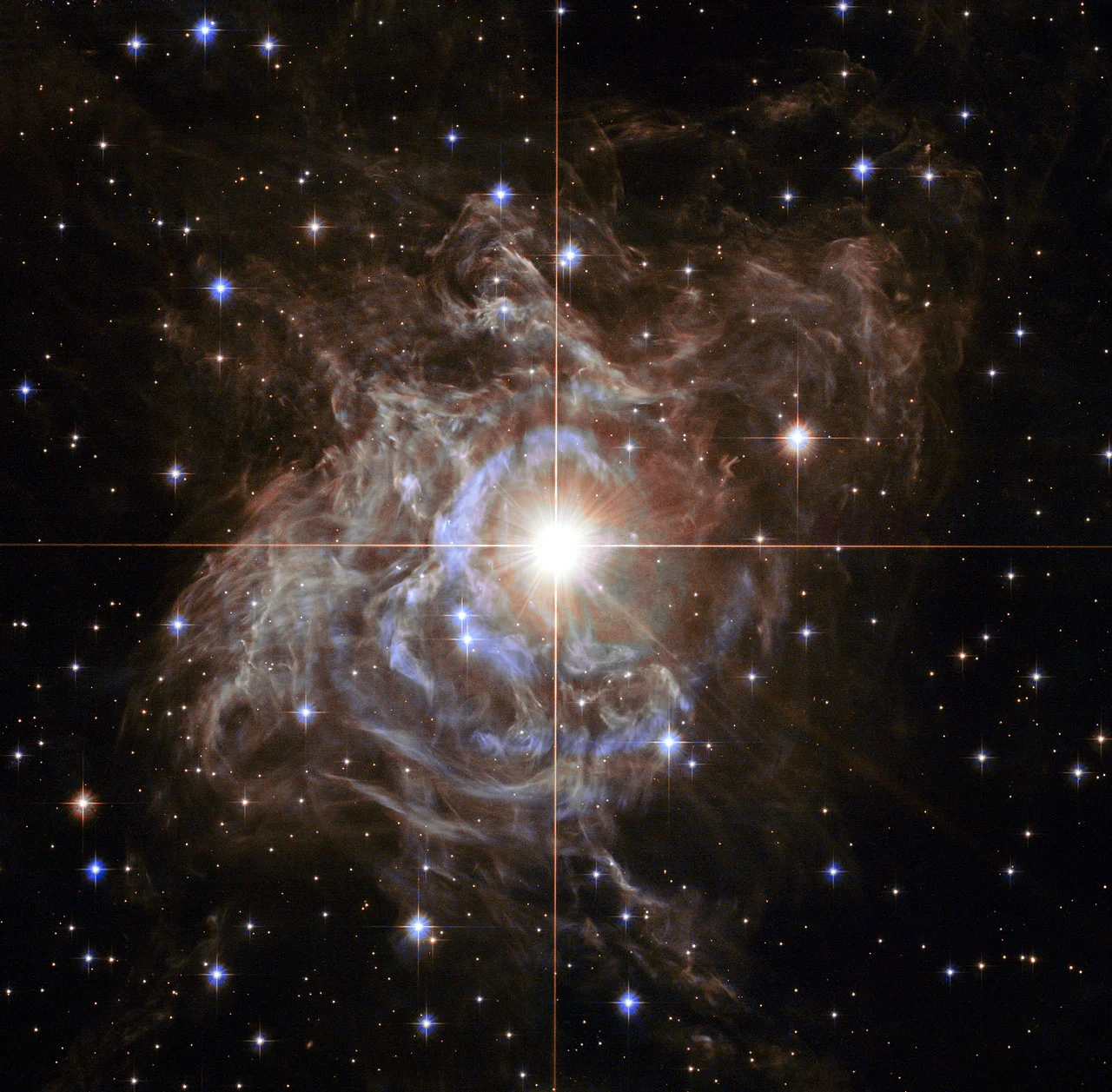
The Cosmic Distance Ladder
Measuring the universe — one rung at a time.
Astronomy began as the art of estimating how far things are. The trick is that no single method works at every scale — so we built a ladder.
Why distance matters
Knowing the distance to a celestial object — given its apparent brightness — yields its intrinsic luminosity, and with it, crucial information about the physical mechanisms of radiation, the properties of matter, and the evolutionary stage of the source. But the connection runs deeper still. The distance to the most remote galaxies provides a direct estimate of the Hubble constant and, consequently, the age of the universe. The distance to globular clusters — formed within one or two billion years of the Big Bang — constrains their ages through stellar evolution theory, placing a lower bound on cosmic chronology.
The self-consistency of this framework remains one of the principal objectives of modern astronomical research.
Geometry and standard candles
The methods for estimating cosmic distances fall into two broad categories: geometric techniques and standard candles. Geometric methods — parallax foremost among them — have the advantage of depending solely on angular measurements, independent of the physical properties of the objects involved. Their limitation is range: stellar parallax reaches only a few hundred parsecs with ground-based instruments, though space missions such as Hipparcos and Gaia have extended this reach to thousands of parsecs with extraordinary precision.
Standard candles, by contrast, are classes of objects whose intrinsic luminosity or physical size is assumed constant across all members of the class, so that observed differences can be attributed to differences in distance. Among the most celebrated are the Cepheid variables — pulsating stars whose period of oscillation is directly related to their absolute magnitude — and Type Ia supernovae, thermonuclear explosions of white dwarfs that attain a remarkably uniform peak luminosity.
Rung upon rung
Each technique has a limited range of applicability. Parallax calibrates the nearest Cepheids; Cepheids calibrate the distances to nearby galaxies; within those galaxies, Type Ia supernovae are identified and their peak brightness measured; and supernovae, visible across billions of light-years, connect us to the expansion rate of the universe itself.
This is the cosmic distance ladder — a chain of interlocking methods, each rung calibrated by the one below. Its strength lies in redundancy; its fragility, in the systematic errors that propagate upward. Every improvement at the base — a more precise parallax, a better-understood Cepheid — reverberates through the entire structure, refining our estimate of the most fundamental number in cosmology … the rate at which the universe is expanding.
NASA · ESA · A. Riess (STScI/JHU)