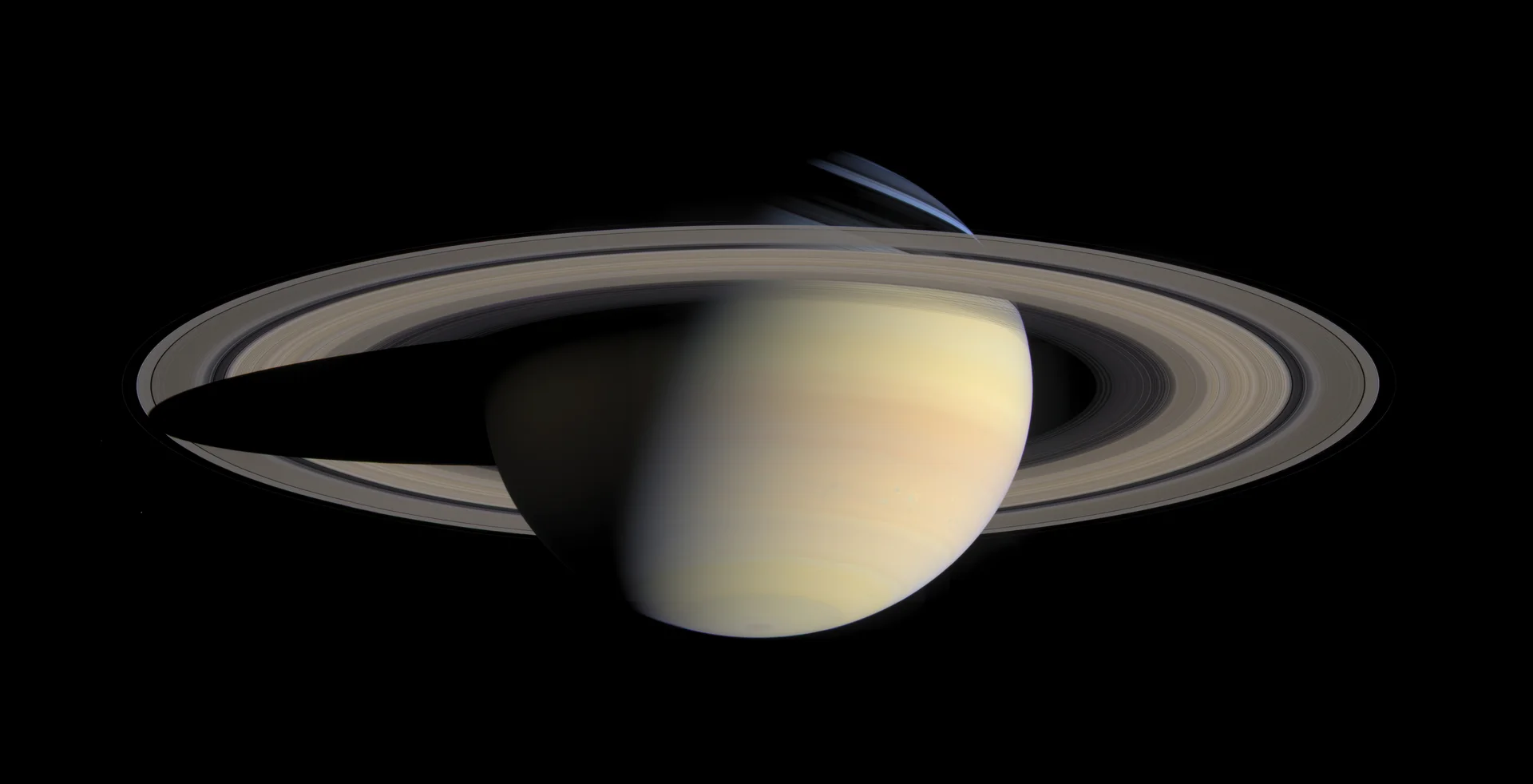
How Saturn Got Its Rings
A lost moon, a broken resonance, and a planet that devoured its own child.
The rings of Saturn look ancient and are not. Two unrelated mysteries about the planet — their youth and its tilt — turn out to share a single, violent answer.
Two mysteries, one answer
Saturn’s rings have long posed an uncomfortable paradox. They are spectacularly bright — composed of nearly pure water ice with negligible contamination — yet dynamical models suggest they are astonishingly young, perhaps only 100 to 200 million years old. A planet that formed 4.5 billion years ago should not possess rings that look as though they were minted yesterday.
The second puzzle is Saturn’s axial tilt: 26.7 degrees, remarkably close to the value expected from a past orbital resonance with Neptune. Yet recent measurements from the Cassini mission revealed that Saturn’s moment of inertia is inconsistent with such a resonance existing today.
A study published in Science by Jack Wisdom and colleagues at MIT resolves both mysteries with a single, dramatic event. Their simulations explored hundreds of scenarios, varying multiple parameters, until one configuration reproduced all observational constraints … the catastrophic destruction of a former moon.
The death of Chrysalis
The team posits that Saturn once possessed an additional satellite — Chrysalis — whose gravitational influence helped maintain the planet’s resonance with Neptune. Some 160 million years ago, Chrysalis’s orbit destabilised. The moon drifted too close to Saturn, crossed the Roche limit, and was torn apart by tidal forces. Its icy debris spiralled into a disc around the planet — the rings we observe today.
The loss of Chrysalis simultaneously disrupted the gravitational balance that had locked Saturn and Neptune in resonance, allowing Saturn’s axis to precess freely to its current orientation.
I don’t like catastrophes — but Saturn’s icy structures can only be compatible with Chrysalis having met a catastrophic end.
The event is the astronomical equivalent of Saturn devouring its own child — a cosmic echo of the myth from which the planet takes its name. What remains in orbit is the evidence of that ancient act of planetary cannibalism … glittering, frozen, and improbably beautiful.
NASA / JPL-Caltech / Space Science Institute