Extraterrestrial Volcanoes
Named after the God of Fire — and found on worlds far beyond our own.
The conviction that Earth was the only living world geologically lasted as long as we had not looked closely. Voyager 1 ended it in three days.
The conviction shattered in spring
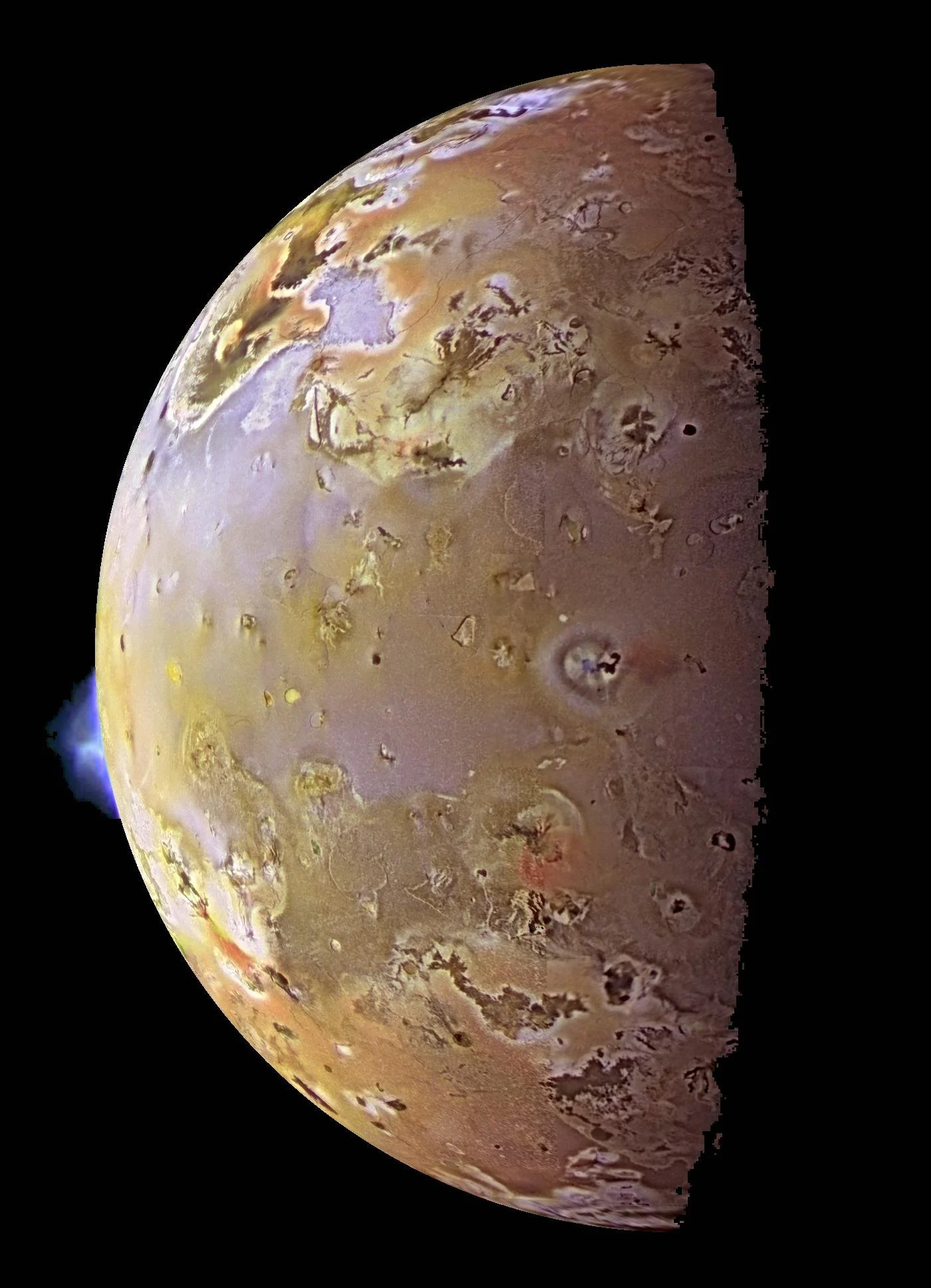
The belief that Earth was the only geologically active body in the solar system — the sole world with intense tectonic and volcanic activity — was annihilated in the spring of 1979, when Voyager 1 passed within 20,000 kilometres of Io.
The landscape was beyond imagination. Instead of the impact craters common across the solar system, Io’s surface was pockmarked with volcanic calderas. The images revealed an infernal world: eruptions, desolate yellow plains where mountains rise and fall — almost daily — by more than 90 metres, vast lava flows, and umbrella-shaped plumes of toxic gas soaring hundreds of kilometres into space. The red-orange hues of this moon stand in stark contrast to the grey neutrality of its neighbours — the colours of sulphur-based minerals, painted across a surface tormented by 80 volcanoes.
Mars, Venus, and beyond
Mars, in the course of its geological history, experienced volcanic activity of extraordinary scale. Olympus Mons — 25 kilometres high and 600 kilometres across at its base — is the largest volcano in the solar system. Its flanks bear lava flows that testify to eruptions spanning hundreds of millions of years, though the planet’s internal heat has long since waned. Venus, shrouded beneath a dense atmosphere of carbon dioxide, conceals a surface dominated by volcanic plains. Radar mapping by the Magellan spacecraft revealed thousands of volcanic structures, some potentially still active.
Even among the icy moons of the outer solar system, volcanism takes unexpected forms. On Enceladus — a satellite of Saturn barely 500 kilometres in diameter — cryovolcanic geysers eject plumes of water ice and organic molecules from fractures near the south pole, fed by a subsurface ocean heated by tidal forces.
What drives the fire
The fundamental determinant of a world’s volcanic destiny is its internal heat. Larger bodies retain their primordial thermal energy for billions of years; smaller ones cool rapidly into geological silence. But tidal heating — the continuous flexing of a moon’s interior by its parent planet’s gravity — can sustain volcanic activity indefinitely, even in bodies that would otherwise have frozen solid aeons ago.
Io is the supreme example: locked in orbital resonance with Europa and Ganymede, it is perpetually squeezed by Jupiter’s gravitational field, generating enough internal heat to resurface itself every million years. The God of Fire does not confine his dominion to Earth … he reigns, in various guises, across the entire solar system.
NASA / JPL