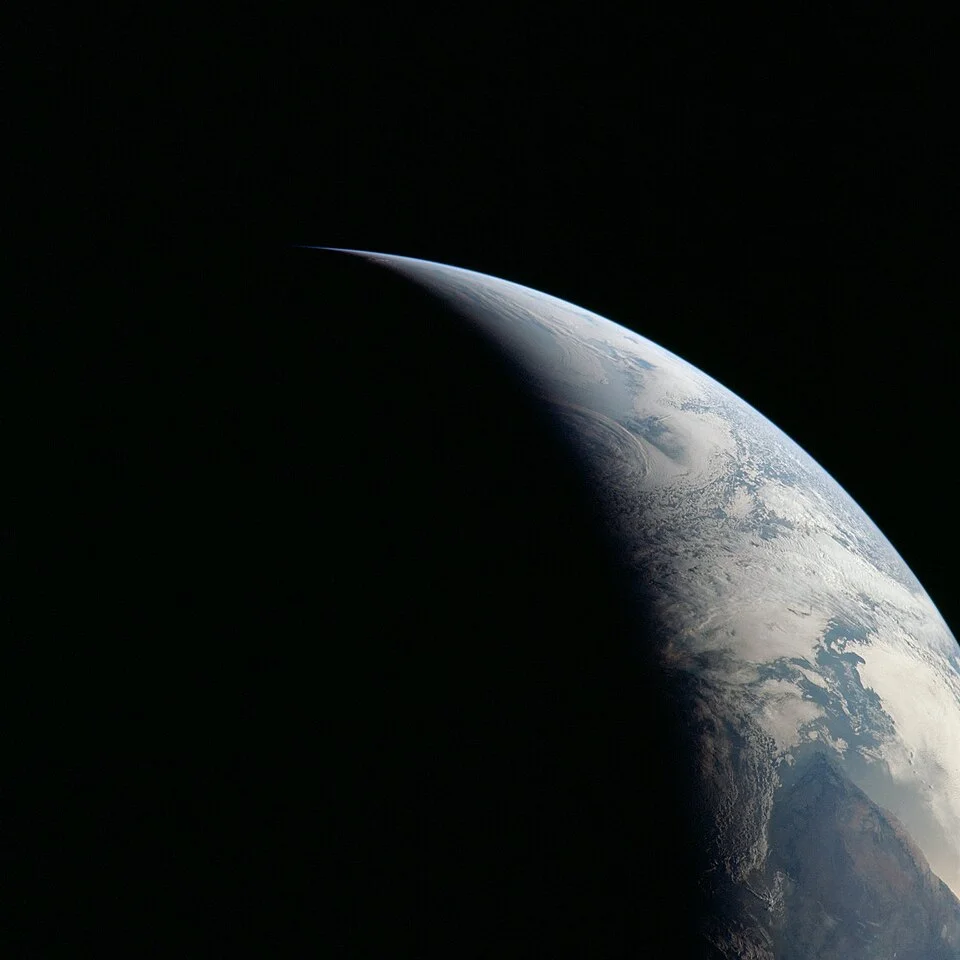
The Terminator
The line that separates day from night — sweeping the Earth at 1,600 km/h.
Twice every day, a moving line crosses every place on Earth at the speed of a jet airliner. We see it as a sunrise. The Moon shows the same line in cleaner form.
A daily visitor
With the exception of the polar regions — where it appears only seasonally — the terminator sweeps across every point on the Earth’s surface twice each day: once at dawn, once at dusk. Although we have largely ceased to observe natural phenomena with the attentiveness of our ancestors, witnessing the terminator’s passage requires nothing more than rising before sunrise … or, more comfortably, watching the Sun descend below the horizon.
At the equator, the terminator achieves its peak velocity: 1,600 km/h. Its orientation shifts throughout the year — nearly parallel to the lines of longitude during the equinoxes, and tilted at its maximum angle of approximately 23.5 degrees during the solstices, mirroring the axial inclination of the Earth.
Not a sharp line
On our planet, the terminator is not a crisp boundary. The atmosphere diffuses incoming sunlight, smearing the transition from day to night across a twilight zone of varying width. Civil twilight, nautical twilight, astronomical twilight — each marks a deeper descent of the Sun below the horizon, a progressively darker stage in the daily drama of light surrendering to shadow.
On an airless body — the Moon, for instance — the terminator is razor-sharp. The absence of atmosphere means that sunlight ceases abruptly at the geometric shadow line, and the contrast between illuminated and unilluminated terrain is absolute.
The best way to observe one
Perhaps the finest way to observe a terminator is to raise your eyes to the Moon. The lunar phases trace the cycle of the Moon’s own day … and the line separating the bright from the dark hemisphere is precisely the terminator, rendered visible across 384,000 kilometres of empty space. Through even a modest telescope, the terminator reveals the lunar surface at its most dramatic — craters, mountains, and rilles cast long shadows that vanish as the Sun climbs higher, only to reappear as it sets on the opposite limb.
It is one of the simplest phenomena in astronomy … and one of the most beautiful.
NASA on The Commons - Apollo 11 Mission Image - View of Earth terminator