The Mystery of the Milky Way
Mapping a city from inside a foggy window.
We have always lived inside the Galaxy, never outside it. Drawing its map has been like sketching a metropolis from a single window — and the picture is still unfinished.
The question
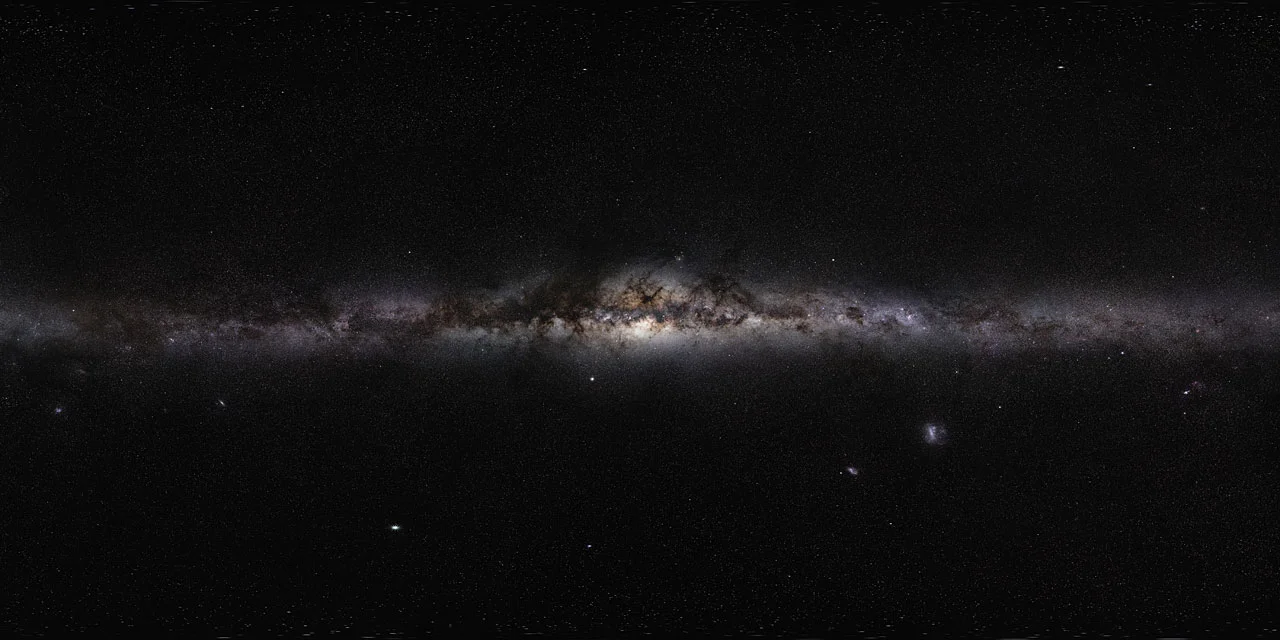
In the past, when humanity lived beneath dark, unpolluted skies, the Galaxy was a nightly companion. And before that magnificent spectacle — the most beautiful that nature can offer — a question arose spontaneously: why is the night sky filled with stars that tend to cluster along a luminous band we call the Milky Way? In other words … where are we?
The need to determine Earth’s position in the cosmos represents one of the fundamental motivations that have driven humanity to study the universe with every means at its disposal. The difficulty was immense: we had to map the geography of our cosmic city without ever leaving our home — like a citizen attempting to understand the layout of a vast metropolis by peering through a foggy window.
The architecture
It took centuries of painstaking observation, a slow and tortuous path through dead ends and false leads, before the magnificent picture began to emerge. The Milky Way is a barred spiral galaxy, roughly 100,000 light-years in diameter, containing over three hundred billion stars. Our Sun resides in the Orion Arm — a minor spur between two of the principal spiral arms, the Perseus arm outward and the Sagittarius arm inward, approximately 26,000 light-years from the galactic centre.
Between the Sun and the Sagittarius arm open immense dark spaces, rich in stars far less luminous than the red and blue giants that delineate the spiral structure. Closer still to the nucleus materialises the Norma arm. These two — Sagittarius and Norma — appear to be the Galaxy’s principal arms, originating from opposite ends of a slightly elongated central bulge that renders our spiral … barred.
The hidden heart
The stars of the bulge occupy a spheroidal volume some 7,000 light-years across and are among the most difficult to study — immensely distant and densely concentrated. They represent a treasure chest, for they almost certainly hold the key to our Galaxy’s evolutionary history. If our eyes could pierce the vast clouds of gas and dust that veil the galactic plane, the bulge would appear as a resplendent golden cloud, ten degrees wide, toward the constellation of Sagittarius — a cloud composed of ten billion stars.
At its very centre resides a supermassive black hole of approximately four million solar masses, around which the entire Galaxy rotates. The exploration of these mysterious inner regions proceeds through radio waves and infrared radiation — the only messengers capable of traversing the interstellar medium relatively undisturbed. What we have found there redefines our understanding of the place we call home.
ESO / S. Brunier