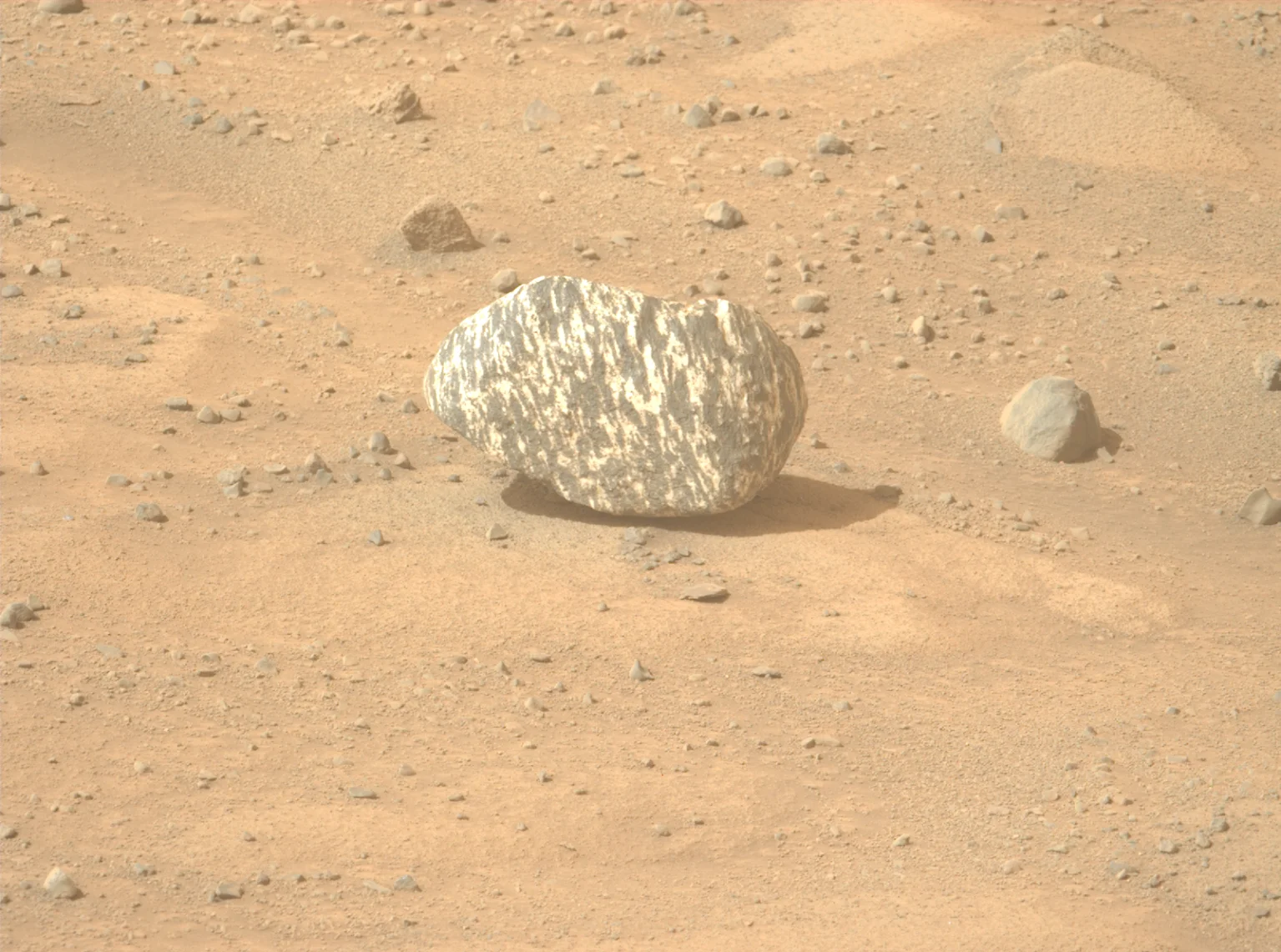
Stones from Mars
How we proved that pieces of the Red Planet have been falling to Earth all along.
There are stones in our museums whose journey began on another world. The proof took twenty years to assemble — and one decisive measurement of trapped gas.
Meteorites are fragments of Solar System bodies torn loose by impacts and cast adrift in space for millions of years — until Earth’s gravity draws them in. Most originate from asteroids. A small remainder divides almost equally between lunar and Martian stones. The Martian meteorites carry the designation SNC, after the initials of the first three specimens recovered: Shergotty (India, 1865), Nakhla (Egypt, 1911), and Chassigny (France, 1815).
But how can we be certain they come from Mars, when no sample has ever been returned from its surface?
The first clue: volcanic youth
Astronomer Eugene Shoemaker and collaborators first proposed in 1963 that impact ejecta from Mars could reach interplanetary space and eventually arrive on Earth. The SNC meteorites displayed striking peculiarities — clear volcanic origin and remarkably young ages. While ordinary meteorites date to the birth of the Solar System (4.56 billion years), some SNCs formed between 1.5 billion and merely 200 million years ago.
This exotic youth offered the first hint. The duration of volcanic activity on a planetary body is directly linked to its size: the larger the planet, the slower it loses internal heat. Asteroids cooled within a few hundred million years; only Venus or Mars could have sustained volcanism recently enough to produce the SNCs. Mars, with its lower gravity, became the prime candidate.
The sceptics’ objection
Opponents countered that Mars’s escape velocity — 5 km/s — made it physically impossible for impact fragments to leave the planet without vaporising. The objection was elegantly simple: if no lunar meteorites had ever been found, despite the Moon being closer and having half the escape velocity, how could we expect Martian ones?
That logical barrier fell in 1982, when geologists recovered an achondrite meteorite from the Antarctic ice — Allan Hills A81005 — and laboratory analysis confirmed it as lunar. From that moment, the anti-Martian faction lost its strongest argument.
The smoking gun
The following year, Vickery and Melosh published a model in Science demonstrating that large impacts could indeed launch Martian surface fragments into space without destroying them, provided the resulting craters exceeded one kilometre. The model predicted significant vitrification — exactly the morphology observed in the heavily glassy SNC specimens.
Then came the decisive, almost accidental discovery. Bogard and Johnson set out to measure gas released by the glassy fragments of the shergottite Elephant Moraine A79001. The argon-40 measurement yielded an absurd age — in excess of six billion years. The explanation: the glass had trapped atmospheric gas from the parent body during formation. When the full suite of trapped gases was measured, their composition proved identical to the Martian atmosphere as recorded by the Viking landers.
Subsequent analyses of other SNC glasses confirmed the result.
The stones in our museums are fragments of Martian soil — launched into interplanetary space by violent impacts, wandering for aeons, and delivered to us.