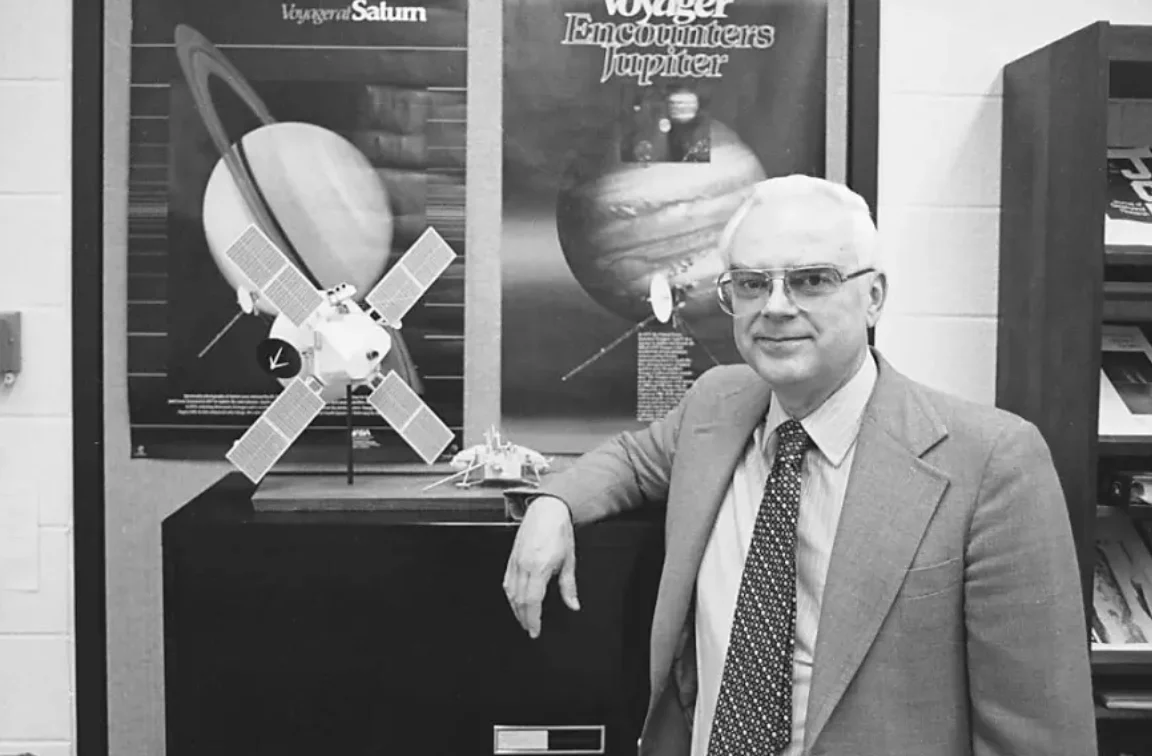
Frank Drake ... Thank You
The man who dared to listen — and taught us how to ask the right question.
In 1960 a young astronomer pointed a radio telescope at two nearby stars and listened. He heard nothing. The act of listening, however, changed everything.
The letter that started everything
Still a young astronomer, Frank Drake was inspired by a remarkable article published by Giuseppe Cocconi and Philip Morrison in Nature on 19 September 1959, entitled “Searching for Interstellar Communications.” The paper proposed that radio transmissions at the 21-centimetre wavelength of neutral hydrogen could serve as a medium for communication across interstellar distances.
The choice of wavelength was not arbitrary. The 21 cm line corresponds to the hyperfine transition of neutral hydrogen — the most abundant element in the universe. When the spins of the proton and electron within a hydrogen atom flip from parallel to antiparallel alignment, the atom radiates a photon at precisely 1,420 MHz. This transition occurs, on average, once every ten million years per individual atom … yet the staggering quantity of interstellar hydrogen renders this the most prominent spectral line in radio astronomy. Any technologically advanced civilisation, Cocconi and Morrison argued, would recognise this frequency as a natural beacon — a cosmic meeting point.
Project Ozma
Drake did not merely read the paper. He acted upon it. In 1960, he pointed the 26-metre dish at the National Radio Astronomy Observatory in Green Bank, West Virginia, toward two nearby Sun-like stars — Tau Ceti and Epsilon Eridani — and listened. Project Ozma, named after the queen of L. Frank Baum’s fictional land of Oz, was the first systematic scientific attempt to detect signals of intelligent extraterrestrial origin.
No signal was found. But the precedent was established — and the question, once posed, could never be retracted.
The equation
In 1961, Drake convened a small conference at Green Bank to discuss the feasibility of detecting extraterrestrial intelligence. To structure the conversation, he wrote on a blackboard an equation that decomposed the problem into a chain of factors: the rate of star formation, the fraction of stars with planets, the fraction of planets capable of supporting life, the fraction on which life actually emerges, the fraction that develops intelligence, the fraction that builds detectable technology … and the duration for which such civilisations broadcast.
The Drake Equation was never intended to produce a precise answer. It was a framework — a way of organising ignorance into manageable questions. Each factor represented a frontier of knowledge, and six decades later, several of those frontiers have advanced enormously. We now know that planets are ubiquitous, that organic chemistry pervades the interstellar medium, that habitable zones are broader than once imagined.
What remains unknown — stubbornly, magnificently unknown — is whether we are alone.
Frank Drake passed away on 2 September 2022. He left behind not an answer, but something more enduring … the courage to ask.
KEYSTONE/AP/CARIN ASHJIAN