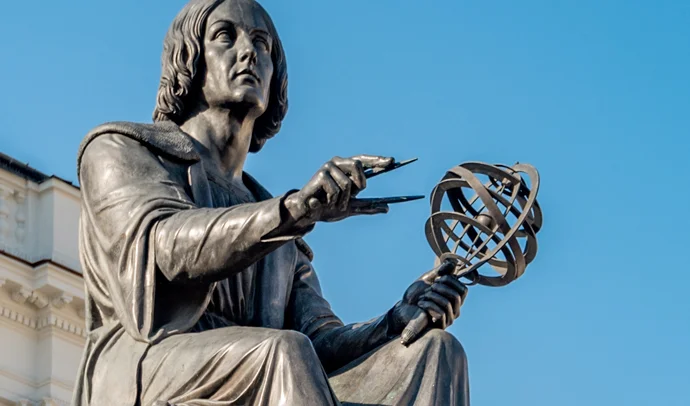
The Legacy of Copernicus
Five centuries of demotion — from the centre of creation to the periphery of a spiral arm.
For fourteen centuries the Earth sat at the centre of everything. The book that displaced it was printed the year its author died — and what it began still has not finished.
The Ptolemaic prison
For more than fourteen centuries, the Western cosmos was conceived according to Ptolemy’s schema: the Earth — immobile, central, the pivot of all things. Stars, Sun, and planets performed their prescribed orbits around humanity, which, as divine creation, stood not merely as spectator but as undisputed protagonist. A complex apparatus of deferents and epicycles sustained the illusion with sufficient approximation for the needs of the age … but its foundations were anything but physical.
Then, roughly five centuries ago, a process began that would sever — permanently — the bond between the scientific understanding of the world and religious anthropocentrism. The sixteenth century inaugurated a systematic demotion of the human role, initiated by Nicholas Copernicus with the De Revolutionibus Orbium Coelestium and completed, three centuries later, by Charles Darwin with On the Origin of Species.
The book that changed everything
When I was working on my doctorate, I had the extraordinary fortune of leafing through one of the exceedingly rare first editions of Copernicus’s masterwork. Few people know it, but the Astronomical Observatory of Capodimonte in Naples preserves one of the handful of surviving copies — a fragile monument to the idea that displaced humanity from the centre of creation.
Copernicus proposed what observation had long hinted at: that the Earth revolves around the Sun, not the reverse. The heliocentric model was not immediately superior in predictive accuracy — Copernicus still relied on circular orbits and required epicycles of his own — but it planted a conceptual seed of immense consequence. The Earth was no longer special. It was … a planet among planets.
From Brahe to Newton
The path from Copernicus to the modern cosmos was neither straight nor swift. Tycho Brahe, the greatest observational astronomer of the pre-telescopic era, compiled measurements of unprecedented precision while advocating a compromise model in which the planets orbited the Sun but the Sun orbited the Earth. It was Johannes Kepler — inheriting Brahe’s data — who discovered that planetary orbits are ellipses, governed by three mathematical laws of breathtaking simplicity. Galileo Galilei, armed with the telescope, provided the observational confirmation: the phases of Venus, the moons of Jupiter, the mountains of the Moon.
The synthesis arrived with Isaac Newton, whose law of universal gravitation unified terrestrial and celestial mechanics in a single mathematical framework. What Copernicus began as a geometrical rearrangement, Newton completed as a physical theory of the cosmos.
The demotion continues
The Copernican revolution did not end with the solar system. In the twentieth century, Harlow Shapley demonstrated that the Sun lies not at the centre of the Milky Way but in its outskirts. Edwin Hubble revealed that our Galaxy is one among billions. The cosmic microwave background confirmed that the universe has no centre at all.
Five centuries after Copernicus, the demotion is complete. Humanity inhabits an unremarkable planet orbiting an ordinary star in the suburbs of a barred spiral galaxy, drifting through a cosmos of staggering indifference to our existence. And yet … it is precisely this demotion that has given us the most magnificent picture of the universe ever conceived — a picture still rich with unknowns, and certainly not definitive.
Tilman2007/Wikipedia