The Andromeda Galaxy
The nearest thing to a mirror the Milky Way has.
The brightest object beyond the Milky Way visible to the unaided eye looks like a smudge of light. It is also the only galaxy heading our way — and we have an appointment.
A smudge with a long history
The first person to write it down was the Persian astronomer Abd al-Rahman al-Sufi, in 964 CE. He called it a “small cloud” in his Book of Fixed Stars. For nine centuries after that, M31 remained exactly that — a smudge, a curiosity, an unresolved patch of light in the constellation that bears Andromeda’s name.
Everything changed in 1923 when Edwin Hubble identified Cepheid variables in the cloud’s outer regions and measured their distances. The smudge was not inside the Milky Way. It was an entire galaxy — a separate island of stars, far beyond anything astronomers had imagined the universe could contain. The discovery settled the Great Debate between Shapley and Curtis in a single observing run and forced cosmology to scale up by orders of magnitude.
What Hubble sees now
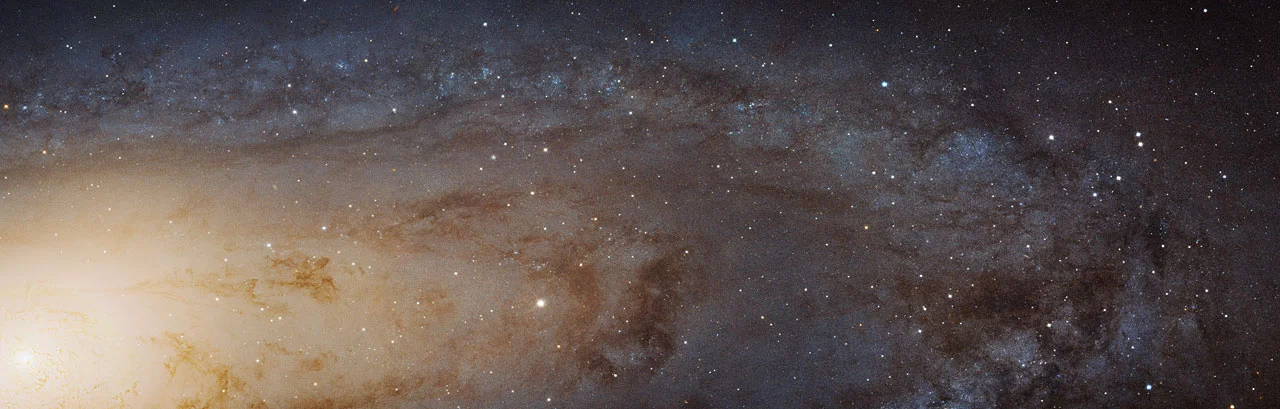
A century later, the space telescope that carries Hubble’s name spent over a decade building the largest mosaic it has ever produced: 7,398 exposures stitched across 1.5 billion pixels, resolving more than 100 million individual stars in a 61,000-light-year strip of Andromeda’s disk. The image reads like a census — hot blue clusters marking recent star formation in the spiral arms, cool yellow populations dominating the central bulge, dark dust lanes threading through everything.
It’s like photographing a beach and resolving individual grains of sand.
At the galaxy’s core, Hubble found a disk of young blue stars orbiting a supermassive black hole estimated at 100 to 230 million solar masses — far larger than the Milky Way’s Sagittarius A*, which weighs in at about four million. The two galaxies are siblings, but not twins.
The collision
M31 is blueshifted. Almost everything else at cosmological distances is moving away from us, but Andromeda is moving toward us — of approach velocity that overwhelms the local Hubble flow. In roughly four to five billion years, the two galaxies will begin their first pass through each other. Stars will not collide — the distances between them are too vast — but the gravitational choreography will distort both disks beyond recognition. Gas clouds will compress, triggering waves of new star formation. The supermassive black holes will spiral inward and eventually merge.
The result, sometimes called Milkomeda, will be a large elliptical galaxy — no spiral arms, no disk, just a diffuse cloud of stars slowly reddening as the gas runs out and star formation dies. The Sun, if it still exists by then, will likely be flung to a wider orbit, watching the sky rearrange itself over hundreds of millions of years.
None of this is speculation. The trajectories are measured, the dynamics modeled. Andromeda is not a destination. It is an appointment.
NASA · ESA · J. Dalcanton · B.F. Williams · L.C. Johnson (U. of Washington) · the PHAT team · R. Gendler