Fossil Light
Astronomy is the only science that cannot observe the present.
Every photon that reaches a telescope is news from a moment that has already ended. The further the source, the older the news — and the more the universe in front of us is no longer there.
Distance is time
The speed of light is finite — 299,792 kilometers per second — and the cosmos is large. That single ratio rewrites how we read the sky. A photon leaving the photosphere of the Sun reaches an Earthbound detector eight minutes and twenty seconds later. By the time it does, the granule that emitted it has dissolved, the magnetic loop has reconnected, the active region has rotated past the limb.
Move outward. Proxima Centauri’s light is four years old when we record it. The Pleiades, four hundred. Andromeda — the most distant object readily visible to the naked eye — sends us photons that began their journey before Homo sapiens existed. The supermassive black hole at its center may have torn apart three more stars since the light left.
A column through time
When the Hubble Space Telescope stared for eleven days at a patch of sky no larger than a grain of sand held at arm’s length, it returned the image below: nearly ten thousand galaxies in a single frame.
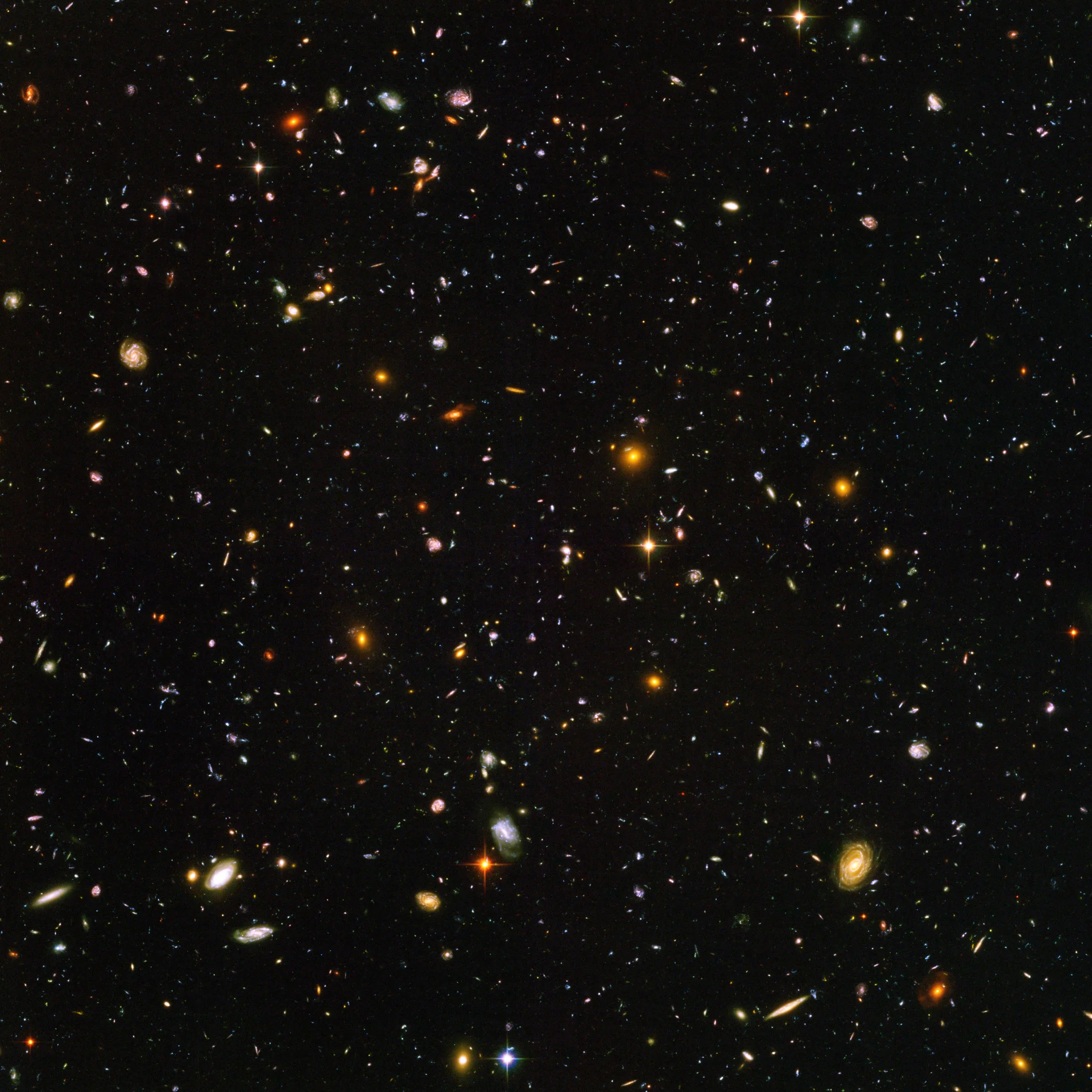
Image: NASA, ESA, and S. Beckwith (STScI) and the HUDF Team
Source: https://esahubble.org/images/heic0611b/
They are not contemporaries. The nearest specks belong roughly to our own epoch; the faintest, reddest dots are seen as they were when the universe was less than a billion years old. A single deep field is therefore a vertical core sample through cosmic history — each redshift slice a different chapter of structure formation, and the chapters cannot be read in any order other than backward.
Astronomy is the only discipline in which the further you look, the older the data.
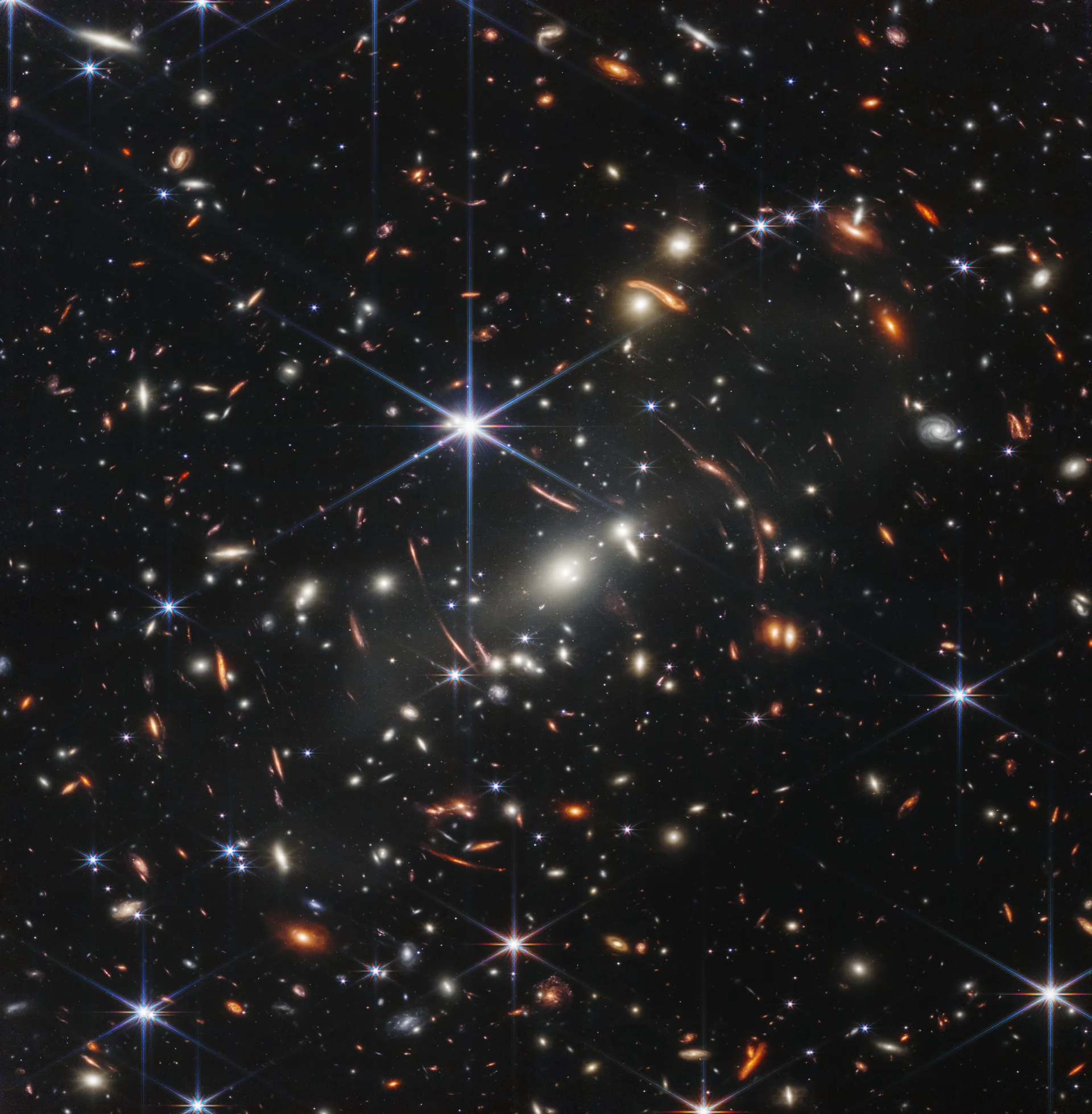
The James Webb Space Telescope has extended this core. Galaxies at redshift 13 — formed when the universe was less than 350 million years old — now glow in JWST infrared because their original ultraviolet has been stretched across most of cosmic time.
The horizon is real
Beyond a certain distance, no light has yet arrived. It is not a wall in space; space continues. It is a wall in access to space. Objects past the cosmic light horizon may exist, may host galaxies and stars and possibly observers, but no signal from them has had time to reach us — and the accelerating expansion of the universe ensures that a great many never will. We are not seeing the cosmos as it is. We are seeing the only version of it that physics will permit us to see.