Stellar Collisions
When stars meet — violently.
A direct hit between two stars is exceedingly rare in the disc of the Galaxy. In the dense cores of globular clusters, it is routine.
A white dwarf — a superdense stellar corpse a hundred times smaller than the Sun yet comparable in mass — bears down on our star at over 600 km/s. The two bodies attract each other like magnets. The white dwarf pierces the Sun like a red-hot blade through butter.
The shock wave compresses and heats the outer layers until fresh thermonuclear reactions ignite. In less than an hour the intruder traverses the Sun from end to end. Our majestic source of light and life becomes, suddenly … only a memory.
Rest assured: among the probable fates of our Sun, this one occupies the very last row. The astrophysicist James Jeans calculated in the twentieth century that no star in the Galaxy’s hundred-billion-strong population has ever witnessed a direct collision — not in the Sun’s neighbourhood, at least.
Where it can happen
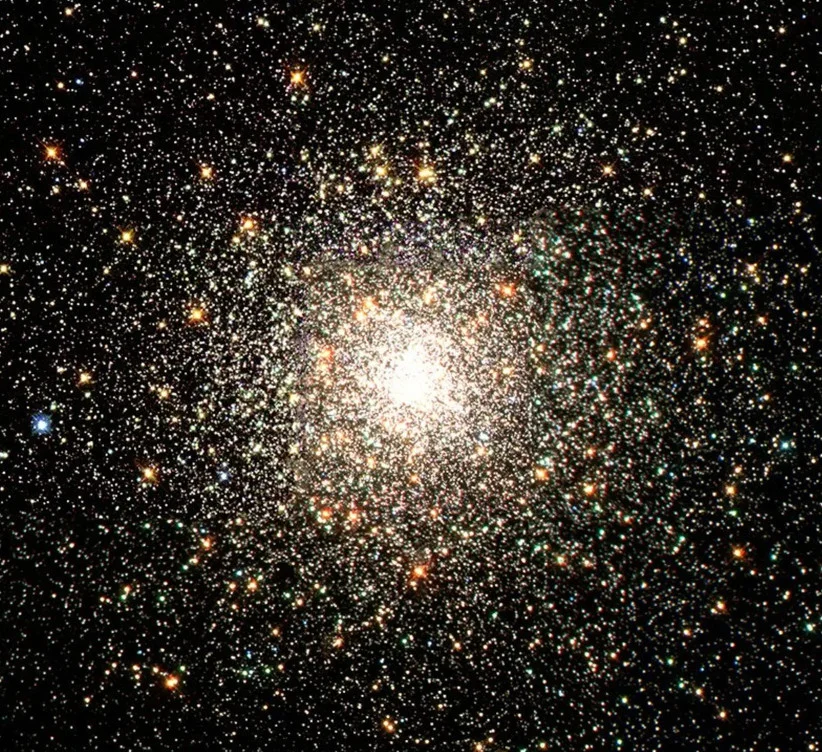
Yet elsewhere the odds are radically different. In globular clusters — dense swarms of hundreds of thousands or even millions of stars packed into a region where ordinary space would hold only a few hundred — the probability of a collision rises by a factor of ten thousand or more.
The motion of stars in a globular cluster is chaotic, reminiscent of a school of anchovies under attack: no single central attractor, every star gravitationally perturbing every other. Less massive stars gradually acquire speed from close encounters and are eventually expelled — a process astronomers call evaporation, recalling a water droplet losing its fastest molecules. The heavier stars, having surrendered energy, drift toward the centre, where their density — and their collision probability — steadily increases.
The Uhuru satellite, launched in 1970, mapped bright X-ray sources across the Galaxy and found roughly 10 % of them inside globular clusters — which contain only 0.04 % of the Galaxy’s stars. That mismatch was the first hard observational clue.
What happens after the crash
When two stars of comparable mass and density collide, they deform each other progressively. No conditions arise to trigger fresh thermonuclear burning; instead, after some mass is ejected, the two merge into a single, peculiar new star. The layers of the progenitors are shuffled, delivering fresh hydrogen fuel to the core of the product. The new star is larger, hotter, and bluer — it looks rejuvenated, a cosmological facelift.
This does not mean it will live longer. On the contrary: being more massive and hotter, it will burn through its nuclear fuel faster. But in the ancient population of a globular cluster, such a star stands out like a teenager in a retirement home — an object that should have vanished long ago.
Behind the apparent silence of the cosmos, extraordinary and sometimes catastrophic phenomena occur — always carrying the seed of renewal or rebirth.