The Astrolabe
The Renaissance computer that fitted in the palm of your hand.
Before there were watches, before there were sextants, there was an instrument that told you the time, your latitude, the position of the stars, and — if you were Muslim — the direction of Mecca. It fit in the palm of your hand.
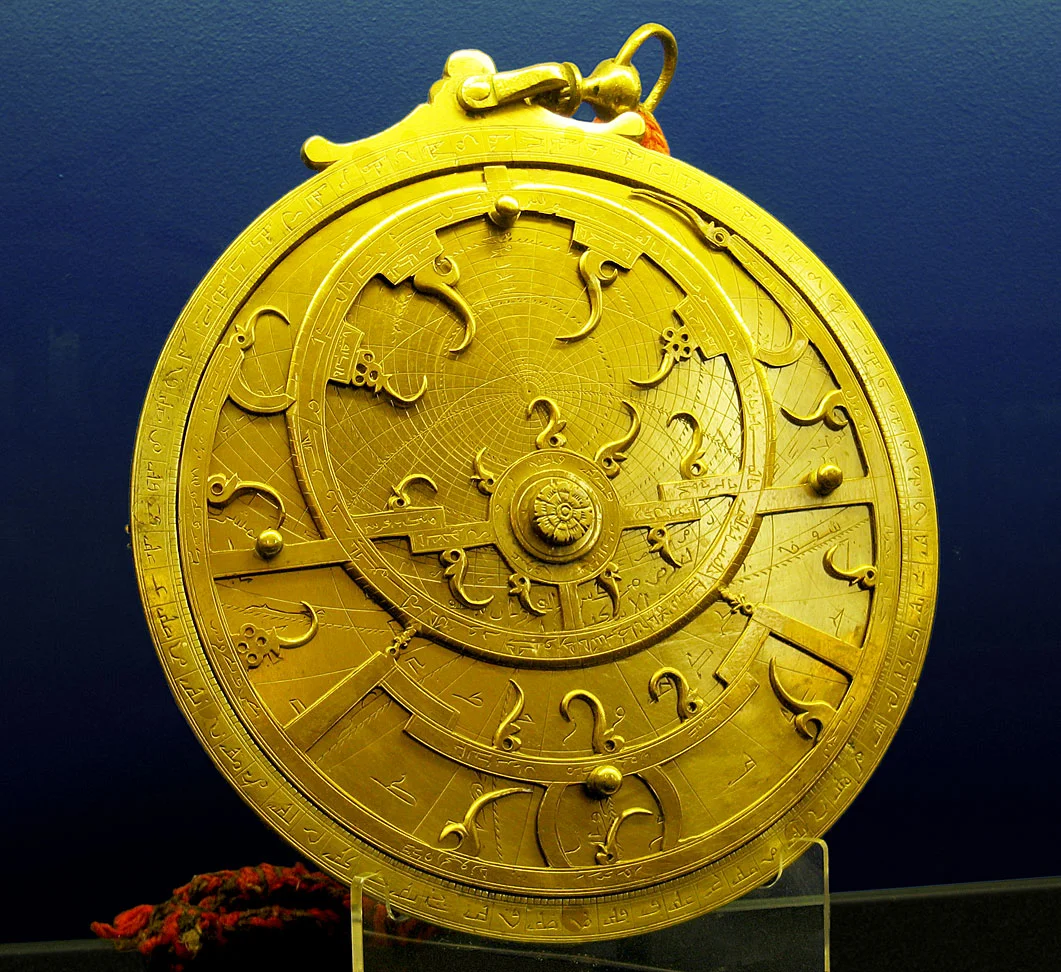
It sits behind museum glass, catching a shaft of light that sets it ablaze with golden reflections — enigmatic and magnificent at once. It draws you in with its colour, its intricate forms, the finely engraved characters it carries. It captivates even the visitor who knows nothing of astronomy.
It is the astrolabe, the most refined instrument the ancient science of the heavens ever produced.
From Nicaea to the Islamic golden age
The astrolabe’s origins recede into classical Greece. Hipparchus of Nicaea, around 180 BC, laid down the stereographic projection on which the instrument rests. Ptolemy later became its foremost theoretical interpreter, though the date of the first physical astrolabe remains unknown. The earliest surviving examples — tenth-century artefacts from the Islamic world — owe their existence to the translation of Greek texts in the eighth century. Beyond telling the time, these instruments could indicate the direction of Mecca, which ensured their rapid diffusion across the Arab world.
From Islam the astrolabe reached Europe through Mediterranean North Africa, spreading via the Christian monasteries of the northern Iberian Peninsula. Its European golden age stretches from the fourteenth to the sixteenth century. Master craftsmen — Gemma Frisius and Gualterus Arsenius in Louvain, Erasmus Habermel in Prague, Georg Hartmann in Nuremberg — turned mathematical theory into objects of irreplaceable artistry, wrought in brass, gold, copper, silver.
A universe compressed into a disc
The astrolabe — literally “star-seeker” — is the planar representation of an armillary sphere. It simulates the apparent rotation of the celestial sphere around the Earth, for a given latitude, and determines the relative position of the stars at any chosen moment.
The mater forms the body of the instrument: a round plate with a raised limb, carrying a suspension throne for hand-held observation. Inside the mater sit the tympanum and the rete.
The tympanum is a disc bearing the stereographic projection of the celestial sphere onto the equatorial plane — tropics, equator, horizon, altitude circles (the Arabic almucantars), and azimuth arcs. Each tympanum serves a single latitude.
The rete — an intricate lattice of curved metal lines — reproduces the ecliptic and the positions of the principal stars, rotating above the tympanum to simulate the diurnal motion of the sky. It is the part where the makers’ artistry finds its fullest expression. The alidade, finally, is a small sighting bar for measuring the altitude of celestial objects.
If you pass through Florence, do not miss the Museum of the History of Science on the banks of the Arno. Let the astrolabes speak: across the insurmountable barrier of time, they will tell you of a distant epoch and the men who distinguished it — as eager as we are to understand how the world works.
If we have come this far, in the long journey of knowledge, we owe it also to them.
Andrew Dunn · Wikimedia Commons · CC BY-SA 2.0