Giant Molecular Clouds
Stellar nurseries written in cold hydrogen and dust.
Most of interstellar space is too hot and too sparse for atoms to ever meet. But cold, dense pockets exist — and that is where stars come from.
Yet there exist regions of space that are less empty — containing clouds of gas and dust left over from the galaxy’s formation. These clouds, far colder than their surroundings, constitute the ideal birthplace for new stars.
From atoms to molecules
When the density of a cloud reaches roughly a thousand times that of the surrounding interstellar medium, atoms begin to combine. The cloud becomes a molecular cloud. Molecular clouds come in wildly variable sizes: in our Galaxy, the smallest have radii below one light-year; the largest stretch across hundreds. Those exceeding 100,000 solar masses earn the designation giant molecular cloud — GMC.
A typical spiral galaxy contains one to two thousand GMCs, alongside numerous smaller molecular clouds. Discovered by radio telescopes about thirty years ago — their constituent molecules emit at radio wavelengths — these clouds proved to be cold environments, roughly 10 kelvin, shielded from the energetic ultraviolet light of nearby stars by their own outer layers. In such frigid conditions, gas becomes compact enough for gravitational collapse to begin.
The density can increase dramatically in the innermost regions, reaching 60 million molecules per cubic centimetre. Though dense by astronomical standards, this gas remains a hundred billion times more rarefied than the air at sea level.
Birth under pressure
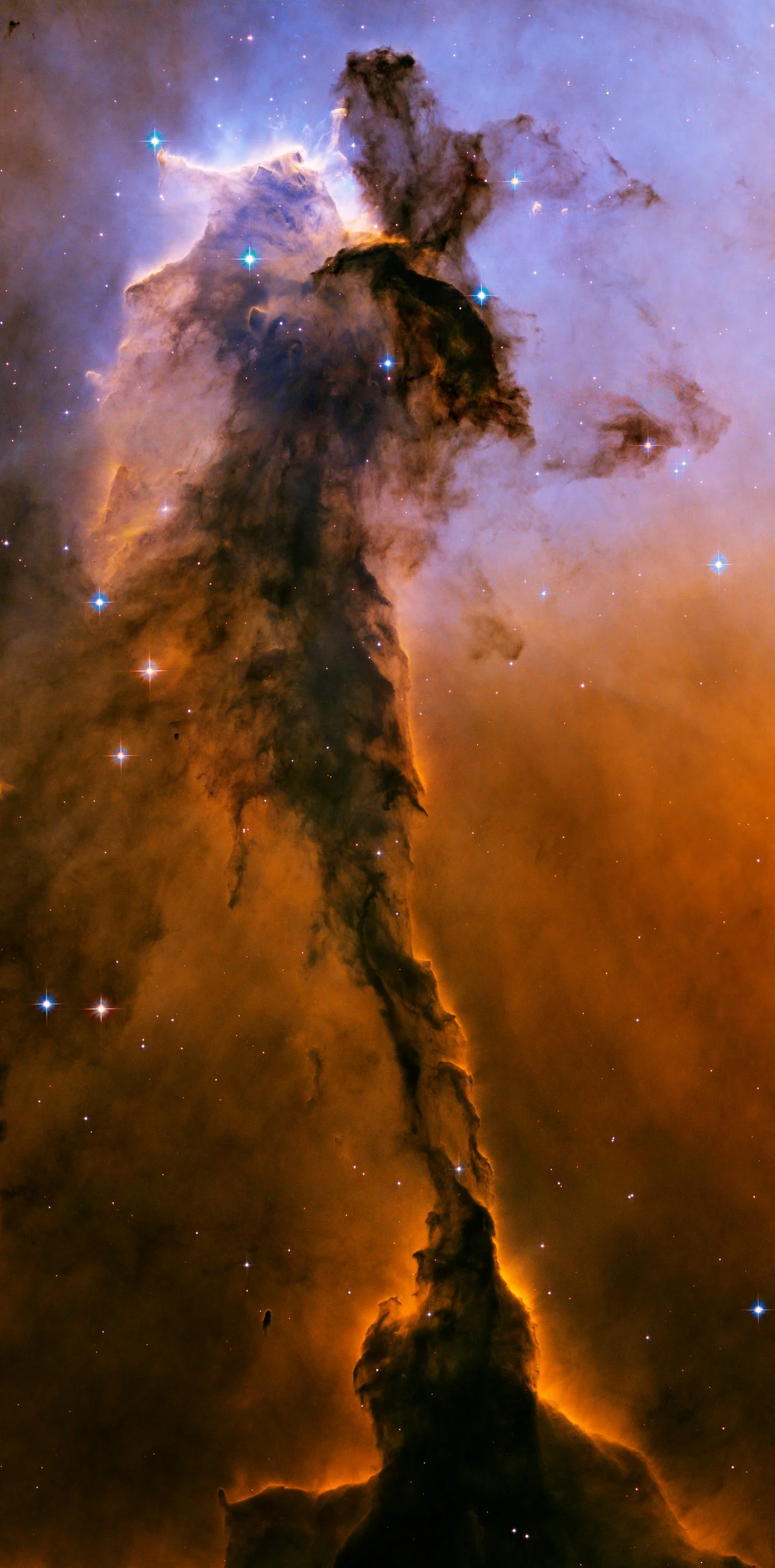
Once the first stars have formed inside a GMC, their own heat begins to dismantle the parent cloud. Powerful stellar winds sweep away the surrounding gas and dust, and the stellar nursery gives way to young, brilliantly luminous stars — initially invisible, detectable only as infrared heat. The famous “elephant trunks” discovered by the Hubble Space Telescope in 1995, emerging from a giant hydrogen cloud inside the Eagle Nebula, are a textbook example of a stellar nursery caught mid-creation.
In the Eagle Nebula, enormous dark pillars of gas and dust — knotted and finger-like — rise within a vast emission nebula. In their obscure interiors, the creation of new stars has been underway for millions of years.
The fate of GMCs inside interacting galaxies — those colliding or merging with neighbours — is dramatically different. Under the colossal pressures generated by such violent encounters, the conditions inside molecular clouds change drastically: star formation accelerates, producing hundreds of thousands of stars before the gas can be heated and dispersed.