Binary Pulsars
Clocks in motion, watched by clocks — and sometimes, mid-experiment, the clock turns away.
A pulsar locked in orbit with another compact body becomes a moving timepiece whose ticks can be tracked to nanoseconds. That precision is what makes binary pulsars the most demanding laboratory we have for gravity — and what occasionally reveals that one of them has stopped pointing at us.
In 2003, a Parkes survey led by Marta Burgay recovered a 22.7-millisecond pulsar in a 2.45-hour orbit. Within months, its companion turned out to be a second, slower pulsar with a 2.77-second period. PSR J0737−3039A and B remain the only double pulsar known.
The system is nearly edge-on. A eclipses B; B’s wind distorts A’s signal at superior conjunction. Together they emit gravitational radiation strongly enough that the orbit is measurably shrinking — by about seven millimetres per day. After sixteen years of timing, Kramer and collaborators have extracted seven post-Keplerian relativistic parameters from the system. The decay matches Einstein’s quadrupole prediction to 1.3 × 10⁻⁴. Among the newly resolved effects are aberrational light bending and retardation in the companion’s strong field — propagation effects currently testable nowhere else.
The pulsar that turned away
Pulsar B has not been seen since March 2008. Its emission cone, dragged by relativistic spin (geodetic) precession at roughly 5° per year, swept off our line of sight. The pulsar is still there. It still pulses. The cone simply no longer points at Earth. Models built during the years of visibility predict the beam will rotate back into view around 2035.
This is not a curiosity. It is a measurement: geodetic precession was a prediction of general relativity, and its rate in this system — slow enough to take decades, fast enough to observe in a human career — confirms the geometry independently of the orbital-decay test.
The clock keeps ticking. It is the lighthouse that turns.
A clock at three depths of gravity
In 2014, Ransom and collaborators identified a millisecond pulsar in a hierarchical triple: PSR J0337+1715, orbiting two white dwarfs, the outer pair circling the inner pair every 327 days. The pulsar’s enormous gravitational binding energy — a sizeable fraction of its rest mass — falls through the field of the outer companion alongside the inner white dwarf’s ordinary mass. If self-gravity gravitated differently from ordinary mass, a violation of the strong equivalence principle, the inner orbit would distort. It does not. Voisin et al. (2020) report |Δ| < 2.6 × 10⁻⁶ at 95% confidence — three orders of magnitude tighter than any previous pulsar bound.
Where the first exoplanets actually were
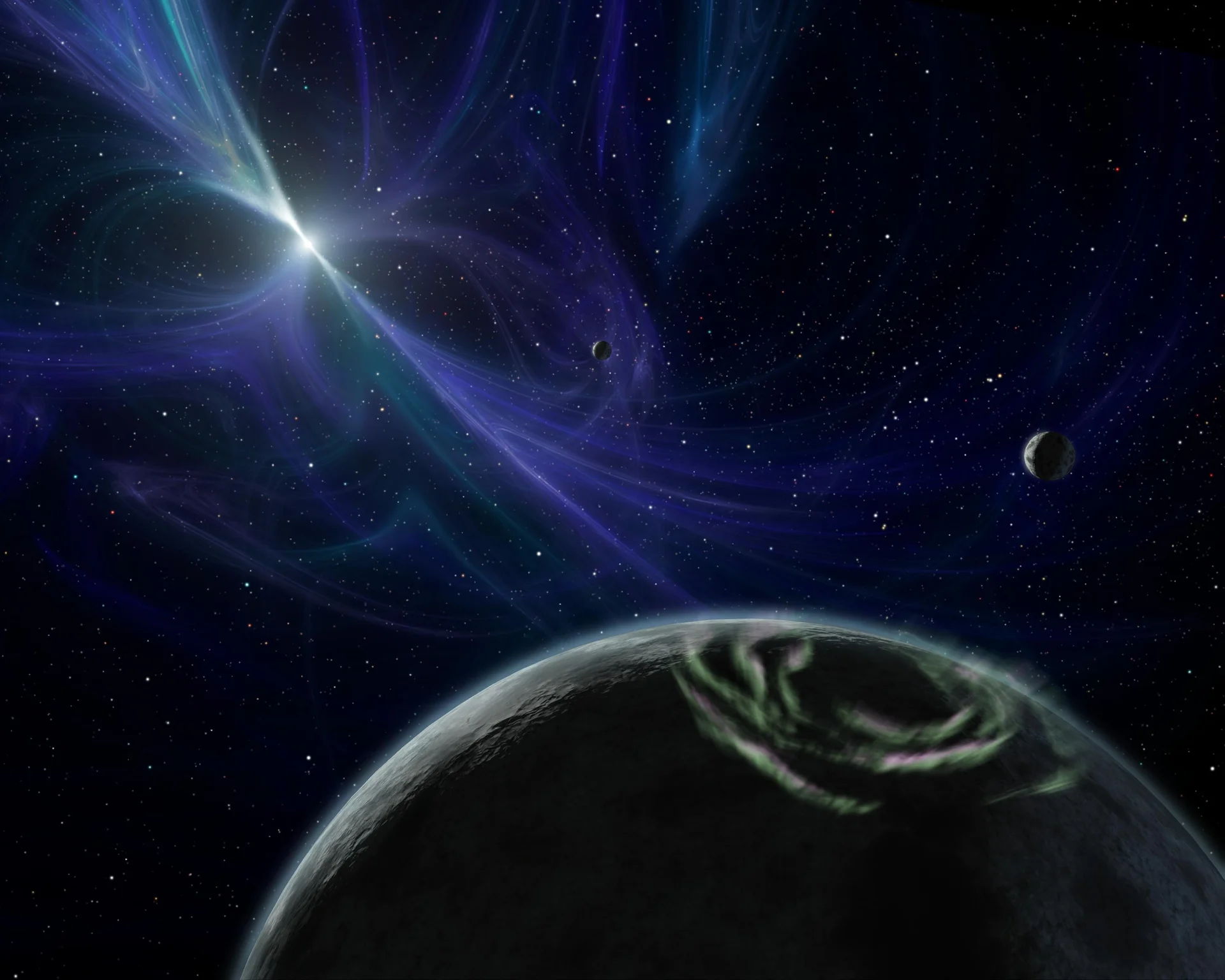
The 2019 Nobel Prize cited Mayor and Queloz’s 1995 detection of a planet around a Sun-like star. Three years earlier, Wolszczan and Frail had already published two Earth-mass companions to the millisecond pulsar PSR B1257+12. A third, lunar-mass body was confirmed in 1994. The system remains the clearest case of rocky planets around a pulsar; they almost certainly formed from a debris disc left after the supernova or by the disruption of a companion — second-generation worlds around an undead star.
The first confirmed planets beyond the Sun were not in twilight orbit around a friendly G dwarf. They were baking in the wind of a neutron star.