Neptune
The planet that was found with the point of a pen.
In the summer of 1846, a French mathematician who had never looked through a telescope wrote a letter to Berlin, telling a German astronomer exactly where to point one. That night, a new planet appeared — within one degree of the predicted position. It was the first world in history discovered not by sight, but by pure mathematics.
The ghost in the orbit
The trouble began with Uranus. By the 1840s, the seventh planet had completed nearly one full revolution since William Herschel discovered it in 1781, and its orbit was wrong. Not catastrophically wrong — the discrepancies were small, fractions of an arc minute — but persistent, systematic, and growing. Newton’s gravitational theory, which predicted the motions of every other known body in the solar system with devastating accuracy, could not account for the way Uranus was drifting. Something was pulling it. Something massive, invisible, and farther out.
Two mathematicians, neither of whom knew of the other’s work, set out to find it. In Cambridge, a twenty-six-year-old named John Couch Adams completed his calculations in the autumn of 1845 and attempted to deliver them to the Astronomer Royal, George Airy, at Greenwich. He called twice, without appointment, and was turned away both times — once because Airy was out, once because the household was at dinner. Adams left his manuscript and went home. Airy eventually read it and wrote back with a query he considered vital. Adams, for reasons never fully explained, did not reply. The prediction of an unknown planet languished, unacted upon, for nearly a year.
In Paris, Urbain Le Verrier — older, more established, famously difficult to work with — was pursuing the identical problem at the urging of François Arago, director of the Paris Observatory. By the summer of 1846, Le Verrier had refined his prediction: the unseen planet should lie at a specific location in the constellation Aquarius, with a specific brightness and a specific angular diameter. The prediction was precise enough to search for — but no French astronomer took up the search. The Paris Observatory, under its aging and unproductive staff, was in no condition to mount a systematic campaign, and Le Verrier’s imperious manner did nothing to inspire enthusiasm. Frustrated, Le Verrier did something that would change everything: he wrote to Johann Galle, a young assistant at the Berlin Observatory who had once sent him a copy of his doctoral dissertation. Le Verrier’s reply — which at last arrived — contained, almost as an afterthought, the predicted coordinates of a planet no one had ever seen.
Galle received the letter on 23 September 1846. That same night, with the reluctant permission of the observatory director Johann Encke, he aimed the Fraunhofer refractor at Le Verrier’s coordinates. His student, Heinrich d’Arrest, suggested they compare the field with a recently printed star chart compiled by Carl Bremiker. Galle called out positions; d’Arrest checked the chart. Within an hour, they found an object of the eighth magnitude that was not on the map. The next night, it had moved. It was a planet, and it lay within a single degree of where Le Verrier had predicted. As Arago would later write, Le Verrier had discovered a planet with the point of his pen.
The discovery detonated a priority dispute between France and Britain that burned far hotter than the scientific question warranted. When news reached England, Airy belatedly revealed that Adams had obtained a similar prediction months earlier — but had never published it, and no British astronomer had acted on it. The French press was furious. The British invoked national honour. Adams himself, to his credit, remained gracious throughout, acknowledging in writing that Le Verrier’s results were published first and led to the actual observation. The two men eventually met, became friends, and left the argument to the newspapers where it belonged.
The planet Galileo saw and did not recognise
There is a coda to the discovery story that borders on the surreal. In 1612 and again in January 1613, Galileo Galilei — observing the moons of Jupiter through his rudimentary telescope — recorded a faint “fixed star” in a position where modern star catalogues show no star at all. Computational reconstructions confirm that the object Galileo sketched was Neptune, passing close to Jupiter during a conjunction. On the night of 28 January 1613, he even noted in his notebook that the “star” appeared to have moved relative to a neighbouring reference point — exactly the behaviour of a planet. But Neptune was near the stationary point of its retrograde loop, barely drifting, and Galileo’s telescope was too crude to resolve a disc. He marked the anomaly with a dot in different ink and moved on. The eighth planet had brushed past the greatest observational astronomer of the age, and he had let it go.
A world that should not work
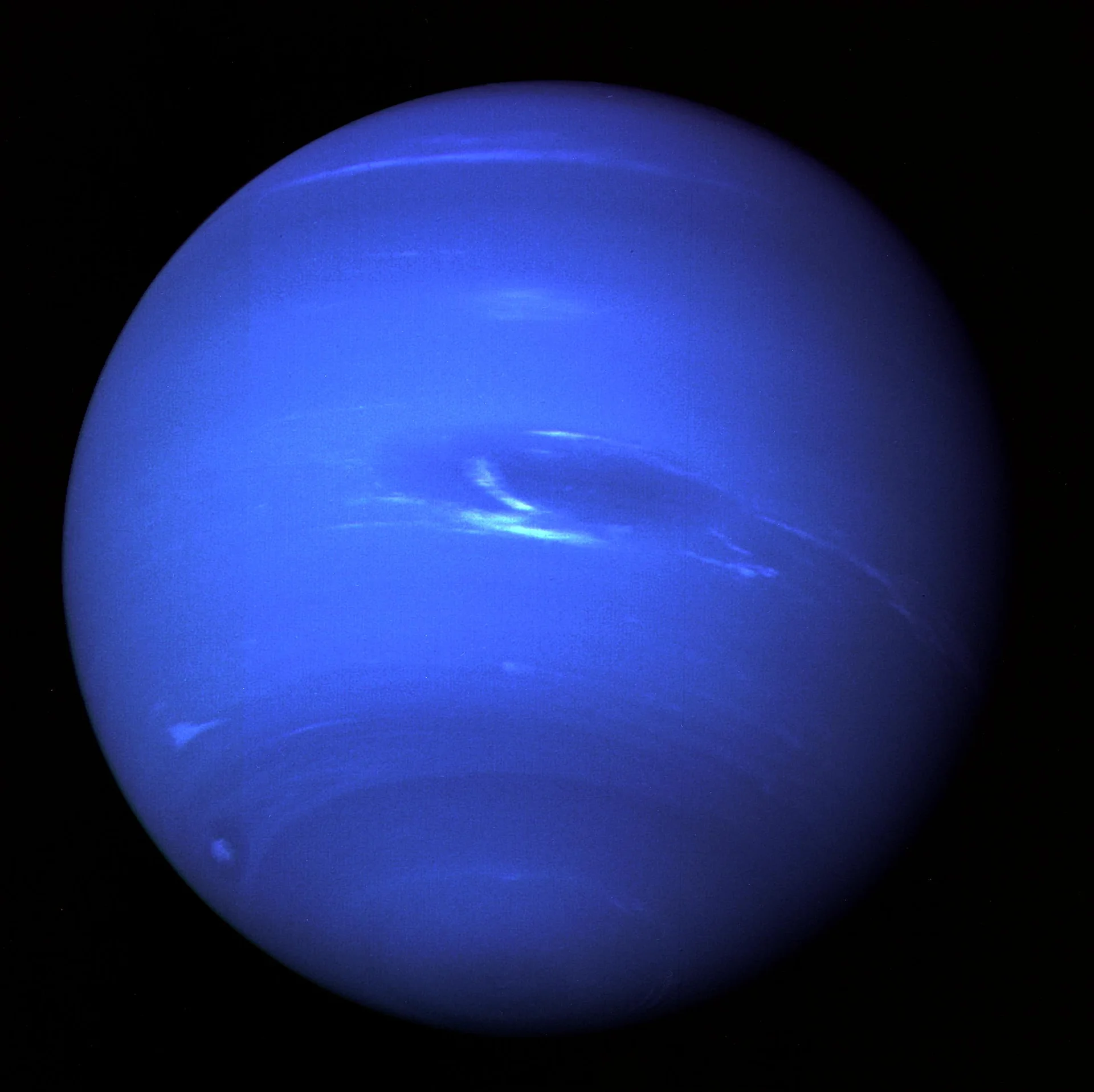
When Voyager 2 arrived at Neptune on 25 August 1989 — twelve years after launch, 4.4 billion kilometres from home — many scientists expected a bland, frozen world. What the probe found instead was violent, beautiful, and deeply strange.
Neptune is the windiest planet in the solar system. Its atmosphere drives jet streams exceeding 2,100 km/h — faster than the speed of sound in air at sea level — in the retrograde direction, opposite to the planet’s rotation. This in itself was baffling: the energy budget of a world receiving a thousandth of the sunlight that reaches Earth should not support such ferocious meteorology. And yet Neptune radiates 2.6 times more energy than it absorbs from the Sun, a surplus whose origin remains contested. Something inside the planet is generating heat — gravitational contraction, chemical differentiation, or processes we have not yet identified.
Voyager discovered the Great Dark Spot, a storm the size of Earth churning in the southern hemisphere, accompanied by bright cirrus-like clouds of methane ice riding at higher altitudes. But unlike Jupiter’s Great Red Spot, which has persisted for centuries, Neptune’s storm proved ephemeral: when the Hubble Space Telescope observed the planet in 1994, the Great Dark Spot had vanished. Others have since appeared and disappeared. Neptune’s atmosphere is in constant, furious reinvention.
The magnetic field was perhaps the deepest surprise. It is tilted 47 degrees from the rotation axis and offset from the planet’s centre by more than half a Neptune radius — a geometry so extreme that it cannot be generated by a conventional dynamo in the metallic core. Current models suggest that the field originates not deep inside the planet but in a thin conducting layer of exotic material — possibly superionic water, a state of matter in which oxygen atoms lock into a crystalline lattice while hydrogen ions flow freely through it like an electric current through a wire. Laboratory experiments have since confirmed that at the pressures found inside Neptune, water can indeed enter this bizarre phase. And there is growing evidence that something even more exotic occurs in the deeper mantle: methane molecules, crushed under millions of atmospheres of pressure, may shed their hydrogen and compress into crystalline carbon. If the models are correct, it rains diamonds inside Neptune — microscopic gemstones precipitating through a dark ocean of superheated fluid, sinking toward the core and releasing gravitational energy as they fall.
A stolen moon
Then there is Triton. Neptune’s largest moon — 2,700 kilometres across, larger than Pluto — orbits in the wrong direction. Every other large moon in the solar system orbits prograde, in the same sense as its planet’s rotation. Triton orbits retrograde: it was not born alongside Neptune but captured, almost certainly from the Kuiper Belt, during the chaotic early reshuffling of the outer solar system. The capture must have been catastrophic for whatever original satellite system Neptune possessed — Triton’s gravitational disruption would have scattered or destroyed pre-existing moons.
And yet Triton is not dead. Voyager 2’s close flyby revealed active nitrogen geysers erupting through the moon’s surface, shooting dark plumes eight kilometres high into a vanishingly thin atmosphere. Its surface temperature — minus 235°C — is among the coldest measured on any solid body in the solar system. Triton is, slowly but measurably, spiralling inward. In roughly 3.6 billion years, it will cross Neptune’s Roche limit and be torn apart by tidal forces, forming a ring system that may rival Saturn’s.
No spacecraft has returned to Neptune since 1989. Everything we know beyond Voyager’s data comes from ground-based and Hubble observations — glimpses, not portraits. The planet that was found with the point of a pen still waits, in deep blue silence, for someone to come back and look more closely.