The First Pulsar
A signal that should not have existed.
In the summer of 1967, a twenty-four-year-old graduate student in Cambridge found a rhythm buried in the radio noise — sharp, cold, perfectly repeating every 1.337 seconds. For weeks, no one could explain it. They half-jokingly labelled it LGM-1: Little Green Men.
A quarter-inch of scruff
The instrument that changed the history of astronomy looked nothing like a telescope. It was four and a half acres of wooden posts and copper wire, strung across a muddy field outside Cambridge — a crude antenna designed to study the scintillation of quasars. Jocelyn Bell, a twenty-four-year-old graduate student from Lurgan, Northern Ireland, had spent two years building it with her own hands: hammering stakes into the wet ground, soldering connections, pulling cable through the English rain. By the summer of 1967, the array was operational and generating data on long rolls of chart paper — roughly thirty metres of it every single day.
Bell’s task was to review all of it. Every centimetre, every trace. She worked through the rolls with a red pen and a ruler, separating quasar signals from terrestrial interference — a painstaking, repetitive labour that no one else in the group particularly wanted to do. And in August 1967, amid the monotony, she noticed something. A small anomaly — a quarter-inch of irregular signal, what she would later describe as “a bit of scruff” — that did not match any known source of interference, yet did not behave like a quasar either. It occupied perhaps one part in a hundred of the paper. Most researchers would have moved on. Bell did not.
She returned to the same patch of sky, night after night. The scruff came back — always at the same sidereal time, which meant the source was tracking with the stars, not with the Earth. It was not a passing satellite. It was not the BBC transmitter at nearby Lord’s Bridge. It was something beyond the solar system, pulsing with metronomic regularity: one sharp burst every 1.337 seconds, unwavering, relentless — as if the universe were tapping its finger on the table, waiting for someone to notice.
Bell brought the anomaly to her supervisor, Antony Hewish. His first response was that she must have made a mistake — a wiring fault, a timing error, an instrumental artefact. She checked everything. She had not. Bell knew her instrument and her data with a thoroughness that, she later admitted, was partly the product of impostor syndrome. She was the only woman in the group, one of the very few non-southern-English voices in a Cambridge physics department, and the quiet fear of being found inadequate had made her obsessively careful. That compulsion — born not of confidence but of its opposite — turned out to be exactly the quality the discovery required.
Little Green Men
What followed were weeks of genuine uncertainty. The team could not identify a natural source capable of producing such a precise, rapid pulse. A star, even a small one, would not possess the physical coherence to oscillate this fast. The signal’s period was stable to better than one part in ten million. Nothing in the catalogue came close. There was a period — brief but real — during which Hewish, Bell, and their colleagues entertained the possibility that the signal was artificial: a beacon, perhaps, from an extraterrestrial civilisation. They labelled it LGM-1, for Little Green Men, and for several uneasy weeks the most extraordinary interpretation remained on the table.
Bell later recalled the peculiar anxiety of that time — not excitement, but dread. If this was truly an alien signal, the implications were staggering, and she found herself annoyed at the aliens for having chosen to interfere with her thesis. She was also troubled by a practical question that no protocol addressed: if you have genuinely detected evidence of extraterrestrial intelligence, whom do you tell first?
The answer came not from a committee but from the sky itself. Over the following weeks, Bell found a second pulsating source. Then a third. Then a fourth — each in a different direction, each pulsing at its own distinct frequency. The alien hypothesis collapsed: it was not one civilisation sending one message, but a class of astrophysical objects, distributed across the Galaxy, doing something that no known physics could yet explain.
On 24 February 1968, the discovery paper appeared in Nature. The editors placed the words “Possible Neutron Star” on the cover. The scientific world responded with an intensity that the press of the day compared to the discovery of quasars.
A lighthouse in the wreckage
The explanation arrived within months — and it was stranger than aliens. Thomas Gold, in a paper also published in Nature, proposed that the signals were not oscillations but rotation. A neutron star — the ultra-dense remnant of a supernova, packing more than the mass of the Sun into a sphere roughly ten kilometres across — spinning on its axis and sweeping a collimated beam of radiation through space like a lighthouse.
The physics was elegant in its violence. When a massive star exhausts its fuel and its core collapses, conservation of angular momentum transforms whatever gentle rotation the progenitor possessed into furious spin. A magnetic field of gauss — a trillion times the Earth’s — channels relativistic particles into narrow jets along the magnetic poles. If the magnetic axis is tilted with respect to the rotation axis, the beam sweeps a cone through space. From Earth, each sweep appears as a pulse. What Bell had found was not a signal sent — it was a signal swept, a searchlight in the ruins of a dead star.
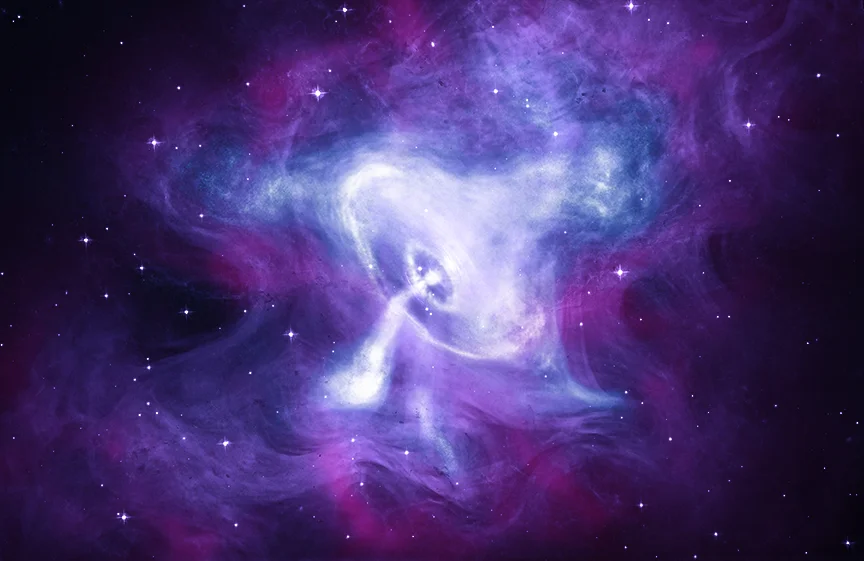
The Crab Nebula provided the most spectacular confirmation. At its heart sits a pulsar completing thirty full rotations every second — the crushed core of the supernova that Chinese astronomers recorded as a “guest star” in 1054 AD. Every feature of the surrounding nebula, from its ethereal synchrotron glow to its violently expanding filaments, is powered by the rotational energy hemorrhaging from that single spinning remnant, ten kilometres wide, nine centuries dead.
The aftermath
The 1974 Nobel Prize in Physics was awarded to Hewish and Martin Ryle. Bell Burnell — who had built the telescope, identified the anomaly in the data, and persisted in its investigation when her supervisor dismissed it — was not included. She did not make a public protest. She quietly finished her dissertation, in which the discovery of pulsars appeared as an appendix, accepted a position in another field, and moved on.
The omission became one of the most debated injustices in the history of the Nobel Prize. Half a century later, in 2018, the Breakthrough Foundation awarded Bell Burnell the Special Breakthrough Prize in Fundamental Physics — three million dollars. She donated every cent to fund scholarships for female, minority, and refugee students pursuing physics research, explaining that she believed underrepresented people bring precisely the kind of fresh perspective that leads to unexpected discovery.
I found pulsars because I was a minority person feeling overawed at Cambridge. Minority folk bring a fresh angle on things.
Meanwhile, the objects she discovered have become some of the most precise measuring instruments in the cosmos. Millisecond pulsars — old neutron stars spun up to hundreds of rotations per second by accreting matter from a binary companion — keep time with a stability rivalling the best atomic clocks on Earth. In 2023, the NANOGrav collaboration exploited exactly this property to report evidence for a gravitational wave background permeating all of spacetime, detected by monitoring the pulse arrival times of 67 pulsars over fifteen years. The dead stars had become a galaxy-sized antenna — a detector spanning tens of thousands of light-years, listening for the low-frequency spacetime ripples generated by orbiting supermassive black holes in the distant universe.
PSR B1919+21, that first signal — the bit of scruff on thirty metres of chart paper that a careful young woman refused to ignore — is still pulsing. It has been pulsing since before anyone was listening, and it will continue long after the chart paper has crumbled. A dead star, speaking into the void with a precision that the living can only envy. All it needed was someone stubborn enough to hear it.