The Slow Crossing
What an interstellar voyage would actually require, with the technology we have today.
It is not a hypothetical that has aged badly. The nearest other star is 4.24 light-years away, and the question of how long the trip would take, with what we actually have, returns an answer that almost no fiction has been honest about.
The numbers behind the romance
For seventy years humanity has put hardware into space. Five spacecraft are now on hyperbolic trajectories away from the Sun, and the fastest of them — Voyager 1 — moves at seventeen kilometers per second relative to its origin. At that speed, in the unlikely event it were aimed at Proxima Centauri, it would arrive in seventy-five thousand years. Every chemical rocket ever flown lives in this regime. Ion drives, now routine on deep-space probes, reach a few times the specific impulse of chemical engines, but their thrust is so faint that they accelerate over years and the trip times still measure in tens of thousands.
The first technology that would bring the crossing inside a single civilization’s span is nuclear pulse propulsion. Between 1958 and 1963, a small group of physicists at General Atomics — Freeman Dyson and Theodore Taylor among them — designed a ship called Orion that would propel itself by detonating shaped fission devices behind a steel pusher plate. The idea is grotesque and beautiful: ride your own bomb. Engineering studies concluded that variants of the concept could deliver between three and ten percent the speed of light. The Partial Test Ban Treaty of 1963 made building one impossible, and nobody has been politically permitted to revisit the decision.
A decade later the British Interplanetary Society’s Project Daedalus replaced fission detonations with inertial-confinement fusion of deuterium and helium-3, and reached an estimated twelve percent c on paper. That paper has remained paper. D–He3 fusion has never been demonstrated at break-even in any laboratory, and helium-3 is essentially absent on Earth: gathering enough for a single voyage would require strip-mining a substantial area of the Moon.
The harder problem is a small Earth
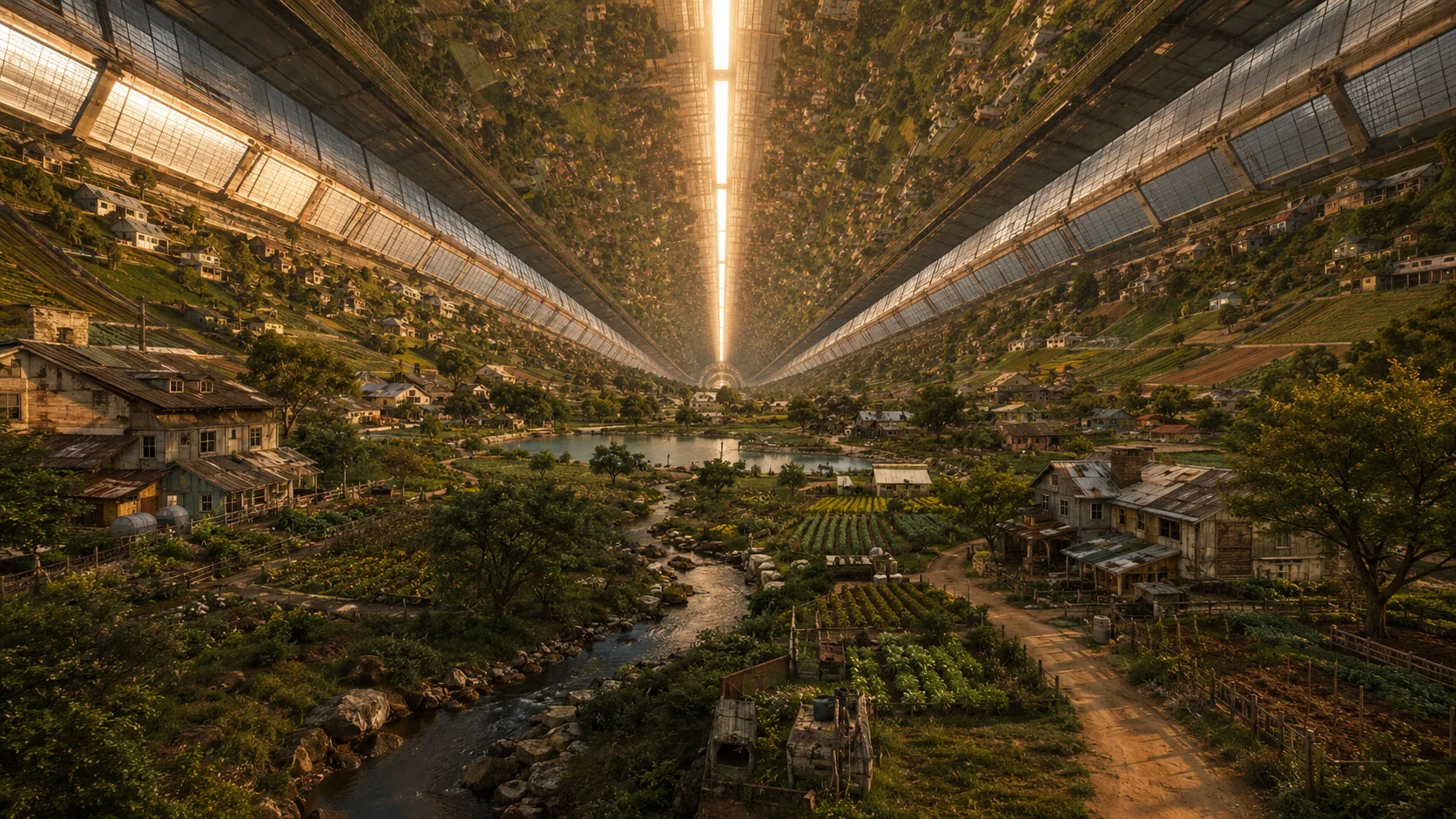
Suppose, generously, that some descendant of these designs existed and the crossing took four hundred years instead of seventy thousand. The voyage would still outlast every passenger and every engineer who built the ship. A sealed metal can, sealed again on launch day, would have to keep humans alive for fourteen generations.
We are not, in any meaningful sense, designing a vehicle. We are designing a small Earth.
And we do not know how to build one. The only mini-world we have ever observed working is the planet we started on. The most ambitious attempt to reproduce it — Biosphere 2, in Arizona, sealed in 1991 — was an enclosure of glass and steel covering 1.3 hectares, with eight people inside and their own atmosphere, ocean, savanna, and rainforest. Within sixteen months oxygen had collapsed to high-altitude levels. The proximate cause was not a calculation error but a missing calculation: as Severinghaus and colleagues documented in Eos in 1994, the soil microbes were respiring more carbon dioxide than the plants could fix, and the building’s concrete was quietly absorbing the rest, locking it into calcium carbonate. Nobody had modeled either pathway. The eight emerged underweight and at odds, having survived an experiment that revealed how much of Earth’s stability is invisible to the people standing on it.
The hardest part of an interstellar voyage is not leaving Earth. It is bringing Earth with you.
The genetic problem is the same kind. Population biologists who have studied multigenerational missions converge on a viable founder population in the low thousands — well above the few hundred imagined in earlier fiction. Below that threshold, accumulated drift and inbreeding compromise the colony before it lands. Cryogenic embryo storage relaxes the mass constraint but transfers it onto a different unsolved technology: frozen human embryos that remain viable for centuries, and an autonomous system capable of raising the first generation without adult humans aboard.
Kim Stanley Robinson worked the same problem out as fiction in Aurora (2015): an arc-ship reaches Tau Ceti after seven generations and finds its onboard ecology degraded in ways nobody had modeled. Half the survivors turn around and come home. The novel’s microbiology and thermodynamics are not invented. They are extrapolated from what Biosphere 2 already taught us.
What today actually permits
The honest inventory is bracing. We can build chemical rockets that escape the solar system in decades but not stars. We have the schematics, but not the test stand or the political consent, for a nuclear-pulse vehicle that could shorten the journey to centuries. We have no closed ecology that survives long-term, no engineered founder population demonstrated in hardware, no radiation regime worked out for crews exposed to galactic cosmic rays for generations.
Every interstellar mission proposed in the last sixty years has run into one of these walls — and the walls all turn out to be the same wall. To leave Earth permanently, we would first have to learn how Earth itself works, in a detail we currently don’t possess. The journey to the stars passes through understanding our own planet.
That may be the most serious reason the project is worth pursuing even if no ship ever launches. It forces a kind of attention to what is already here that we have not, so far, been willing to pay.
Raffaele Battaglia — generated with GPT Image 2 (OpenAI), 2026 — artist's impression, conceptually plausible, not to scale.