A Moon Still Moving
Its interior is still cooling — and its crust is still breaking.
The Moon looks geologically dead. Its crust says otherwise.
A world we mistook for dead
For most of human history, the Moon has been the canonical image of geological permanence. The lines on its face had been there before we existed; the dark maria, the bright highlands, the immense rayed craters — all of it seemed engraved in something so cold and so old that nothing could ever happen there again. Even after Galileo turned his telescope upward in 1610 and saw mountains where Aristotle had insisted on perfect spheres, the prevailing verdict remained unchanged. The Moon had once been violent. It had long since fallen silent.
This was not, in fairness, a foolish conclusion. The Moon is only about one-eightieth of the Earth’s mass, and the thermal destiny of a planetary body is decided largely by its size. Small worlds lose heat faster than large ones; their reservoirs of radioactive elements are smaller in absolute terms; their internal engines run out of fuel more quickly. By every reasonable scaling, the Moon should have exhausted its thermal life billions of years ago — its mantle solidified, its core inert, its surface frozen into whatever configuration it had assumed at the close of the last great epoch of mare volcanism. The geological clock, we assumed, had stopped.
It had not.
The scarps that should not be there
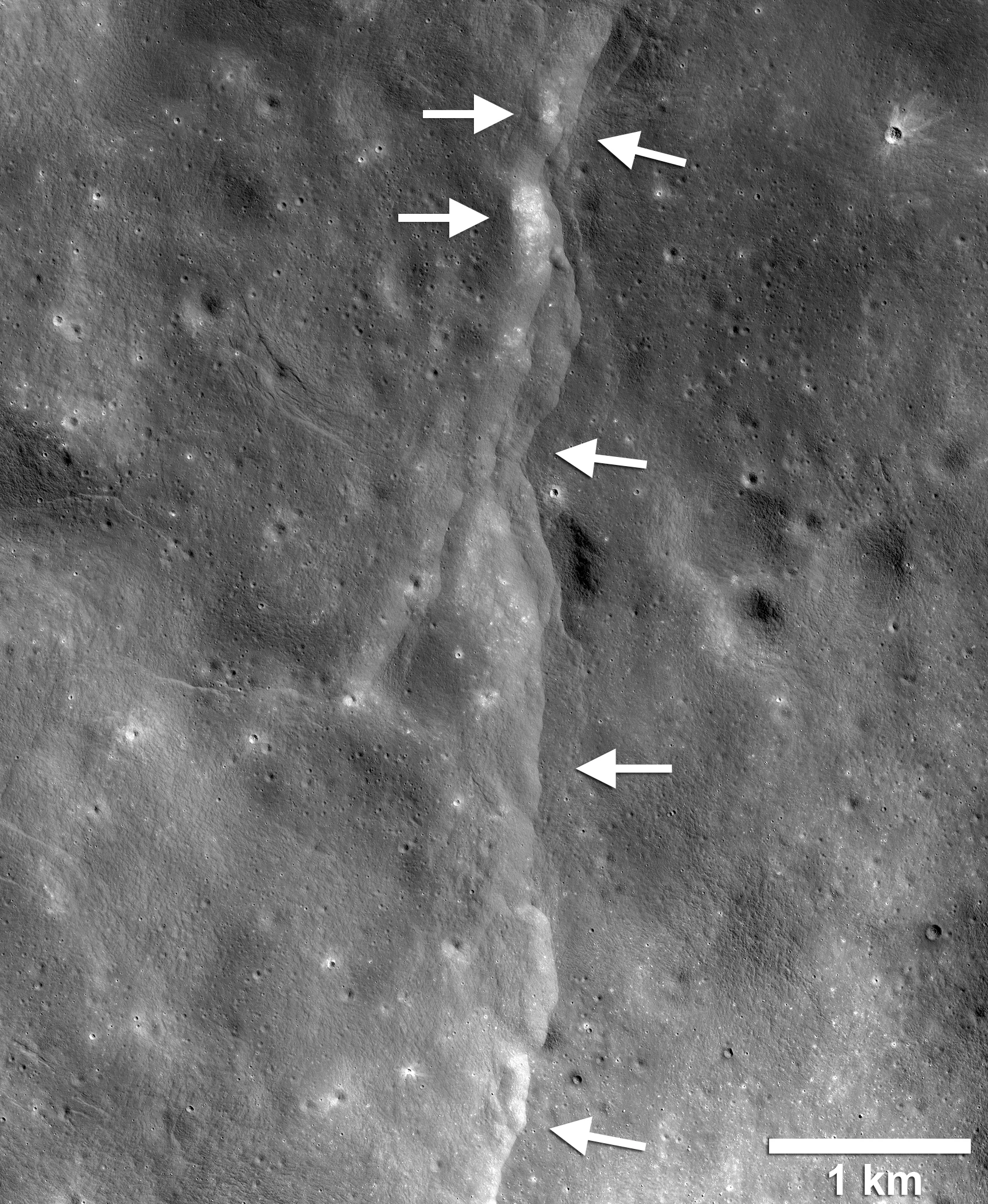
In June 2009, NASA’s Lunar Reconnaissance Orbiter arrived in orbit around the Moon, carrying a narrow-angle camera capable of resolving features less than a metre across. Within months, planetary geologists were noticing something peculiar in the high-resolution frames coming back from its detectors: stair-step ridges, lobed at the front like a frozen wave, where one block of crust had clearly been pushed up over its neighbour. They are technically known as lobate scarps — typically tens of metres high, a few kilometres long, with crisp profiles and almost no impact craters laid over them.
A handful of such features had been recognised since the Apollo Panoramic Cameras of the early 1970s, but their occurrence had appeared to be restricted to the equatorial zone where those cameras happened to look. The Lunar Reconnaissance Orbiter Camera began finding them everywhere. At high latitudes, in the lunar highlands, on the far side. In a landmark paper published in Science in August 2010, Watters and colleagues catalogued fourteen previously unknown examples, half of them above sixty degrees of latitude, and argued that their global distribution and their evident youth pointed to a single, startling conclusion. By 2015, the count exceeded three thousand. By the time of the 2019 follow-up, the camera had imaged more than thirty-five hundred.
Their distribution is global. Their morphology is unmistakable. Their relative youth is implied by the sharpness of their edges and the small impact craters they crosscut without being overlain by larger ones in turn. Lobate scarps are the surface expression of thrust faults — small earthquakes frozen in topography — and on the planetary scale they testify to one thing alone.
The Moon is contracting.
The slow shrinking of a small world
What makes a planetary body shrink?
Heat — or, more precisely, the loss of it. When a rocky world cools, the volume of its mantle and core decreases. On Earth, this contraction is dispersed and absorbed into the ordinary work of plate tectonics: the lithosphere is broken into mobile fragments that slide past, dive under, and override one another, redistributing stress across a planetary mosaic. On the Moon, no such accommodation is possible. The lithosphere is a single, rigid shell — a closed envelope of cold rock laid over a slowly cooling interior. When the interior contracts beneath it, the shell, too brittle to follow smoothly, fractures. One block is forced over another. The scarp is what is left behind.
From the cumulative shortening expressed by the catalogued faults, the Moon’s radius has decreased by roughly fifty metres over the last several hundred million years. It is a small number on the scale of a body 1737 kilometres in radius. It is also, in another sense, an enormous one — for it implies that the cooling has not stopped, and that the contraction is still in progress, and that somewhere beneath the regolith the lunar interior is still, slowly, surrendering the heat of its own formation.
The grape, by imperceptible degrees, has been becoming a raisin.
But how recently has all this happened? And — the question that matters — is it still happening now?
What the Apollo seismometers heard
Between July 1969 and September 1977, four passive seismometers operated continuously on the lunar surface, deployed by the crews of Apollo 12, 14, 15, and 16. (A fifth, placed by Apollo 11, functioned only for three weeks before its electronics failed.) The network was sparse, the data was noisy, and the Moon turned out to be seismically far quieter than the Earth — but it was not silent.
Among other classes of events, the seismometers recorded twenty-eight shallow moonquakes: ruptures at depths between tens and a few hundred kilometres, distinct in their seismic signature from the much more numerous deep tidal quakes that occur near the lunar core. Some of these shallow events reached moment magnitude five — strong enough to dislodge boulders on a steep slope, strong enough to throw an astronaut off his feet. Their waveforms more closely resembled tectonic earthquakes on Earth than any other class of lunar seismic event. But for decades the epicentres remained too poorly constrained — by the geometry of only four detectors — to associate any of them with a specific surface feature. The quakes were known to exist. They simply belonged to nowhere in particular.
In May 2019, in a paper published in Nature Geoscience, Watters and colleagues reanalysed the entire Apollo seismic record using a relocation algorithm designed for sparse networks. The new epicentres told a story the original analysis could not have told. Eight of the twenty-eight shallow quakes turned out to fall within thirty kilometres of a known thrust-fault scarp — the radius over which strong ground shaking from such a fault would be expected. Six of those eight occurred when the Moon was near apogee, the farthest point in its orbit, where the tidal stress imposed by Earth’s gravity reaches its maximum compressional value, and where slip on a contraction-driven thrust fault is therefore most likely.
A Monte Carlo simulation, run ten thousand times, returned the probability of such a coincidence — in space and in orbital phase, by chance alone — at less than four percent.
The conclusion is now difficult to escape. The Moon is not a fossil. Its faults are still slipping. Its crust is still breaking, in obedience to a heat source that has not yet finished giving up.
Walking on an active fault
There is a coda to this story, and it belongs to the human exploration of the Moon.
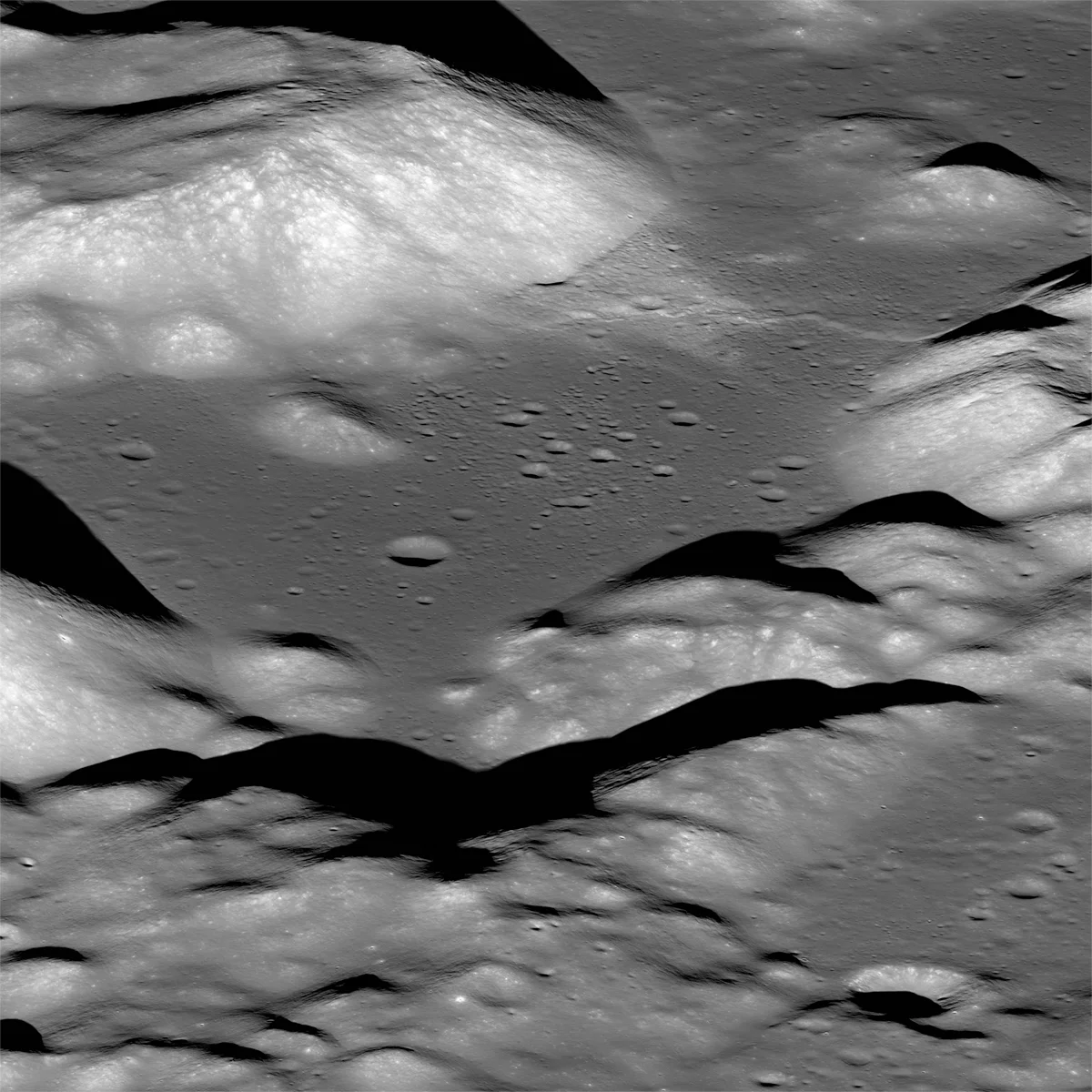
The Taurus–Littrow valley, photographed from orbit by the Lunar Reconnaissance Orbiter. The Lee–Lincoln scarp — a low, curving cliff some eighty metres high — runs north–south across the valley floor, cutting between the South Massif (left) and the North Massif (right). The Apollo 17 landing site lies just east of the scarp. Image: NASA / GSFC / Arizona State University Source: https://www.nasa.gov/news-release/shrinking-moon-may-be-generating-moonquakes/
The largest of these features in the Taurus–Littrow valley, on the south-eastern shore of Mare Serenitatis, is the Lee–Lincoln scarp: a curving, low cliff that runs from the slopes of the South Massif to those of the North, cutting across the valley floor at a height of about eighty metres. It is also the only extraterrestrial fault scarp ever traversed by human beings. On 13 December 1972, during the third and final EVA of Apollo 17, Eugene Cernan and Harrison Schmitt drove their lunar rover up and over its slope on the way to North Massif. They examined the boulders that lay along its base — boulders that had rolled down, in the geological past, from sources high above. They had no way of knowing that the cliff they were crossing was active.
One of the moonquake epicentres relocated by the 2019 reanalysis lies about thirteen kilometres from the spot where they parked the rover.
And on the slopes of the South Massif above the landing site, the Lunar Reconnaissance Orbiter Camera has since imaged a series of features that may be the visible signatures of those events: landslides streaking down the flanks of the massif, bright patches of regolith freshly exposed to the dark of space, narrow tracks where boulders have rolled and stopped. Bright surfaces on the Moon do not stay bright for long; the steady micrometeoroid rain darkens them over geological time. Their freshness is itself a clock. What it appears to be measuring is the recent past.
Selenography, in its strictest sense, is the geography of the Moon. But the geography of the Moon, it turns out, is not a static thing. It is a record being written now — at a pace too slow for human attention, but too fast for cosmic stillness. The Moon is still moving. And we have already, without realising it, walked across one of its living faults.