The Cepheids
How a pulsating star became the ruler of the universe.
Some stars do not shine steadily. They swell and contract on a clockwork rhythm — and the rhythm itself, it turns out, tells us how far away they are.
In the long quiet rooms of the Harvard College Observatory, in the years before the First World War, a woman named Henrietta Swan Leavitt sat at a desk with a magnifying glass and a stack of glass photographic plates. The plates had been taken from the Observatory’s southern station in Arequipa, Peru, and they showed a small luminous smudge in the sky of the southern hemisphere — the Small Magellanic Cloud. Leavitt’s task, assigned within the rigid hierarchy of the Observatory where women were employed as human “computers,” was to find the stars on those plates that flickered.
She found 1,777 of them.
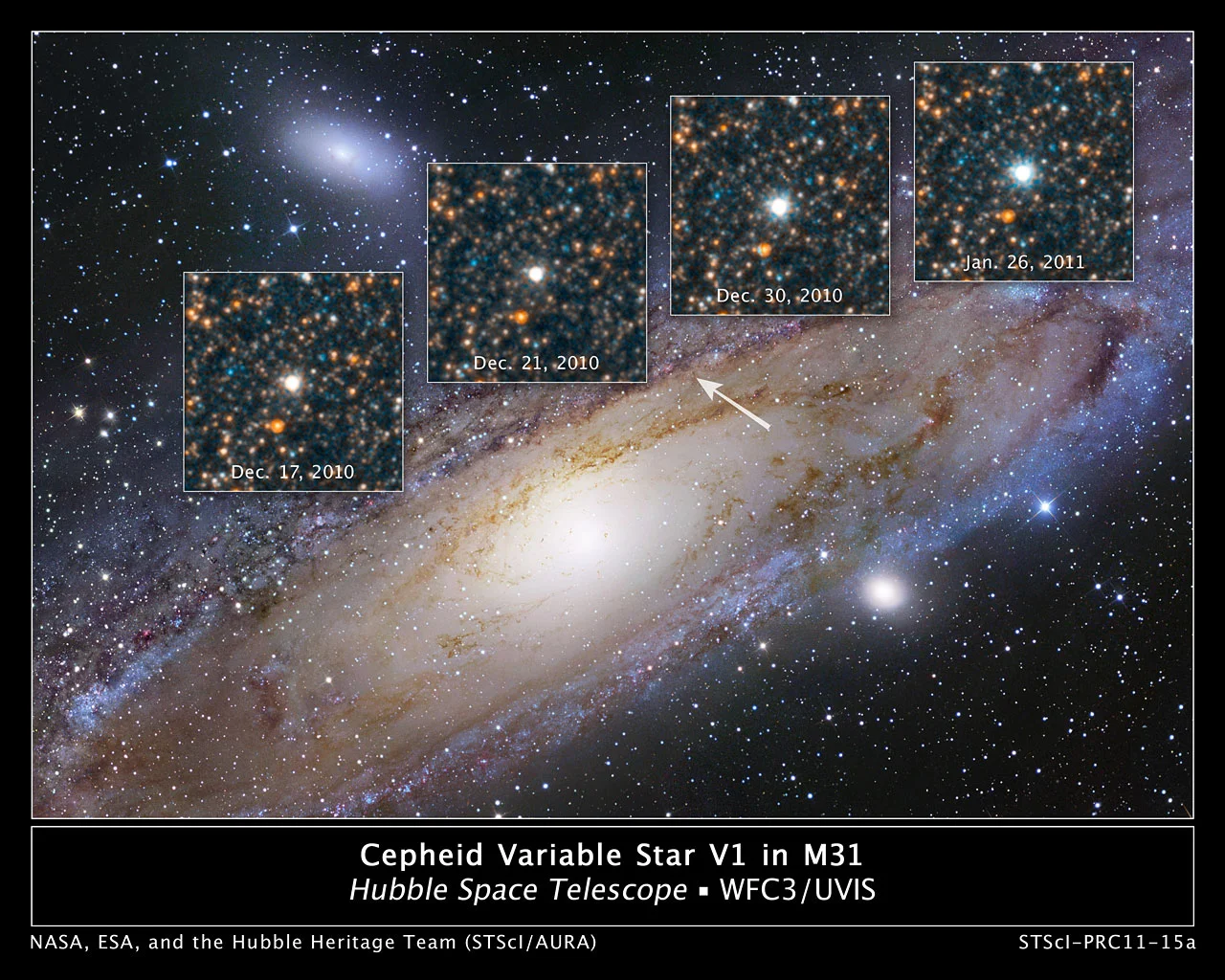
Among that swarm of variables, a subset behaved in a peculiar way. They did not blink erratically, as novae do; they did not dim and brighten in mutual eclipse, as binaries do. They breathed — swelling and dimming on a steady, repeating rhythm that ran from a day or two up to several weeks. And as Leavitt tabulated them, she noticed something extraordinary: the brighter the star, the longer its breath. Plot the apparent brightness against the logarithm of the period, and the points fell along a clean straight line. Because every variable in the Small Magellanic Cloud sat, to a first approximation, at the same distance from Earth, the apparent magnitudes were telling her about intrinsic luminosities. The rhythm of the pulsation announced the brightness of the star. And once you knew a star’s true brightness, comparing it to what you saw at the eyepiece gave you its distance. In a three-page communication published in 1912, Leavitt had handed astronomy its first cosmic ruler.
The variables she had been cataloguing were Cepheids.
What makes a star breathe
The class takes its name from Delta Cephei, a fourth-magnitude star in the northern constellation of Cepheus, whose variability was first noticed by the young deaf English astronomer John Goodricke in 1784 — two years before he died, at the age of twenty-one. For more than a century afterward, no one knew why such a star should pulse. The breakthrough came in 1917, when Arthur Eddington proposed that Cepheids were not eclipsing pairs, as some had suspected, but single stars expanding and contracting under their own gravity. The specific engine that drives the pulsation, worked out in the 1950s by Sergei Zhevakin and refined by John Cox, runs in a particular layer deep inside the star, where helium is partially ionized.
When the star contracts, this layer is compressed; its opacity rises; radiation streaming up from the interior is trapped behind it; pressure builds; the layer is pushed back out. As it expands, it cools, opacity falls, the trapped radiation escapes — and the star, having lost its support, begins to fall back in. The cycle is exquisitely periodic because it is set by the star’s own structure: its mass, its radius, its mean density. The bigger and more luminous the star, the longer the period. That is precisely what Leavitt had measured, four decades before anyone understood why.
Cepheids occupy a narrow vertical band on the Hertzsprung–Russell diagram known as the instability strip. A star evolving away from the main sequence crosses this strip on its way to becoming a red giant; while inside it, the ionization layer sits at exactly the right depth for the engine to run. Cross the strip, and the star begins to pulse. Leave it, and the breath ceases.
The ladder
Consider, then, what such a star offers an astronomer. Its rhythm announces its luminosity; its apparent brightness announces its distance. A pulsing Cepheid is, in effect, a self-labelling lighthouse. And these are not subtle lighthouses: the brightest classical Cepheids outshine the Sun by tens of thousands of times, luminous enough to be picked out as individual stars across tens of millions of light-years.
In October 1923, at Mount Wilson Observatory, Edwin Hubble photographed a faint star in the outer arm of the Great Andromeda Nebula. He marked it on the plate as a possible nova; then, comparing with earlier exposures of the same field, he saw it brightening and fading on a month-long cycle. He crossed out the N he had written and scrawled “VAR!” in red pencil. He reached for Leavitt’s relation. The period gave him the luminosity; the luminosity, compared to the dim apparent glow of the star, gave him the distance. Andromeda was not, as some had insisted, a nearby gas cloud within our own Milky Way. It was nearly a million light-years away. It was its own galaxy.
In a single calculation, the universe had become unimaginably larger.
The rhythm of a pulsing star, read aloud, became a measuring stick laid across the cosmos.
There would be one further correction. By the early 1950s, the distances Hubble had derived to nearby galaxies appeared subtly wrong — Andromeda came out smaller than the Milky Way, which seemed implausible. Walter Baade, observing from California with the new 200-inch telescope at Palomar, announced at the 1952 IAU meeting in Rome that there were in fact two distinct populations of Cepheid-like pulsators: the classical Cepheids that Leavitt had observed in the young, metal-rich SMC, and an older, fainter family — now called Type II Cepheids — that haunt globular clusters and the galactic halo. The two had been conflated. When Baade separated them, the distance to Andromeda roughly doubled, and with it, the scale of the visible universe.
The ladder today
A century after Leavitt’s three-page paper, Cepheids still occupy the foundational rung of what astronomers call the cosmic distance ladder. Their pulsations are now anchored against geometric parallaxes from the European Space Agency’s Gaia mission, which has measured the distances to dozens of Milky Way Cepheids precisely enough to calibrate the entire scale to roughly one percent. Those calibrated Cepheids are then identified by the Hubble Space Telescope, and recently by JWST, in galaxies tens of millions of light-years away, where they fix the brightness of Type Ia supernovae — the next rung up — which in turn carry distance measurements out to the edge of the observable universe.
The whole structure of modern cosmology — the expansion rate of the universe, its age, the inferred presence of dark energy — rests on this chain. And the chain, today, refuses to close. The expansion rate measured locally, climbed up rung by rung from Cepheids and supernovae, disagrees with the rate inferred from the cosmic microwave background by roughly five standard deviations. Whether the discrepancy will be resolved by new physics, or by some unseen systematic in the way we read pulsing stars, is one of the central open questions of twenty-first-century cosmology.
Henrietta Leavitt did not live to see any of it. She died of cancer in 1921, at fifty-three, before Hubble had even pointed his calculation at Andromeda, and decades before the dispute her measurement now governs. She had been paid thirty cents an hour to compute. What she left behind … was a way of knowing how far apart things are.